
Advertising vs. Marketing: Roles, Examples, and Metrics
April 23, 2026
Author: Shusaku Yosa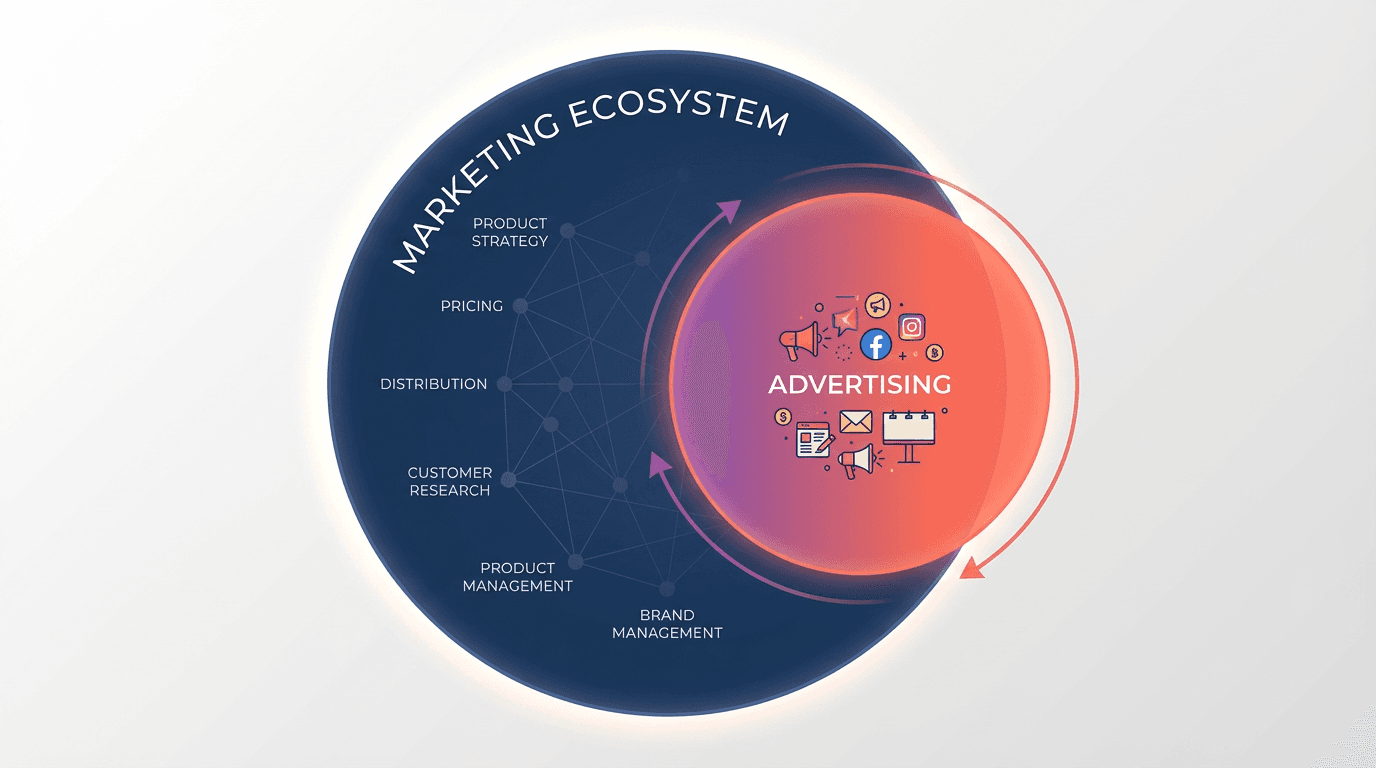
Marketing covers the work of creating and delivering value that customers choose. Advertising is one way to communicate that value and encourage action. When the underlying problem is the offer, price or purchase path, increasing ad spend alone may not solve it.
Compare the roles
The AMA’s marketing definition includes creating, communicating, delivering and exchanging value. Advertising primarily contributes to the communication part of that broader system.
Dimension | Marketing | Advertising |
|---|---|---|
Scope | Customer understanding, offer, price, distribution, promotion and retention | Paid messages distributed through media |
Question | What value should we provide, to whom and how? | What should we communicate, to whom and where? |
Measures | Revenue, profit, retention and customer satisfaction | Exposure, visits, useful outcomes and cost |
Collaboration | Product, sales, support and finance | Creative, media operations, measurement and sales |
Locate the problem with the 4Ps
The 4Ps are Product, Price, Place and Promotion. Advertising belongs within Promotion, which also includes methods other than paid media. Consider a fictional training service for small businesses.
P | Decision in the fictional service | Evidence |
|---|---|---|
Product | Practical training for first-time managers | Participant problems and follow-up questions |
Price | Included services and payment conditions | Customer decision reasons and delivery costs |
Place | Online attendance and a corporate booking process | Booking usability and internal approval needs |
Promotion | Search ads and sample learning material | Valid inquiries, bookings and spend |
Before assuming good training will sell with more exposure, align the audience, eligibility, schedule, price and booking process. Alternatives include internal training and doing nothing, not only competing providers.
Distinguish communication from other barriers
Observation | Hypothesis to investigate | Primary collaborators |
|---|---|---|
Intended customers do not know the offer | Message or channel does not reach them | Marketing and advertising |
Visitors discover they are ineligible | Ad promise conflicts with product conditions | Advertising and product |
Many late-stage price questions | Inclusions and price are unclear | Product, pricing and sales |
Bookings stop partway through | Form, payment or approval friction | Site operations and sales |
Few customers continue after training | Experience does not match expectations | Product and support |
These are hypotheses, not diagnoses from traffic data alone. Use customer questions and operating records to understand causes. Advertising teams need partners who can address product and commercial constraints.
Connect metrics through one business journey
In a fictional example, 200 ad-driven visitors produce ten valid inquiries and two corporate bookings. The visit-to-inquiry rate is 5%; the inquiry-to-booking rate is 20%. Evaluate training delivery cost and profit as well as ad spend. These are illustrative numbers, not forecasts or benchmarks.
If CTR rises while valid inquiries fall, investigate whether the message attracts unsuitable demand. If inquiries increase but bookings fall, review price, proposals and eligibility alongside advertising. A single platform measure rarely describes the whole problem.
A shared decision worksheet
Record the customer, problem, promised value, alternatives, relevant 4P, owner, outcome measure and review date. State which customer behavior the change is expected to affect.
Share results across sales, product and support. Keeping advertising reports connected to business decisions helps the team identify whether the next investment belongs in reach, the offer or the experience after the click.
Related guides
- Social Media Advertising: Platform Selection, Budgeting, and Measurement
- B2B Advertising: Choose Channels and Measure Pipeline Quality
- Content Marketing vs. SEO: Goals, Tactics, and Shared KPIs
Review your results consistently
For ongoing data aggregation, comparison and reporting, review NeX-Ray’s integrations and features. Check the plan requirements for your analysis, then start for free.
Sources and verification
Public documentation checked on October 1, 2026. Availability and interface details can vary by account and market; check the linked documentation before configuring a campaign.