
What is a Hot Lead? Differences from Warm and Cold Leads, Plus How to Nurture Them
April 30, 2026
Author: Shusaku Yosa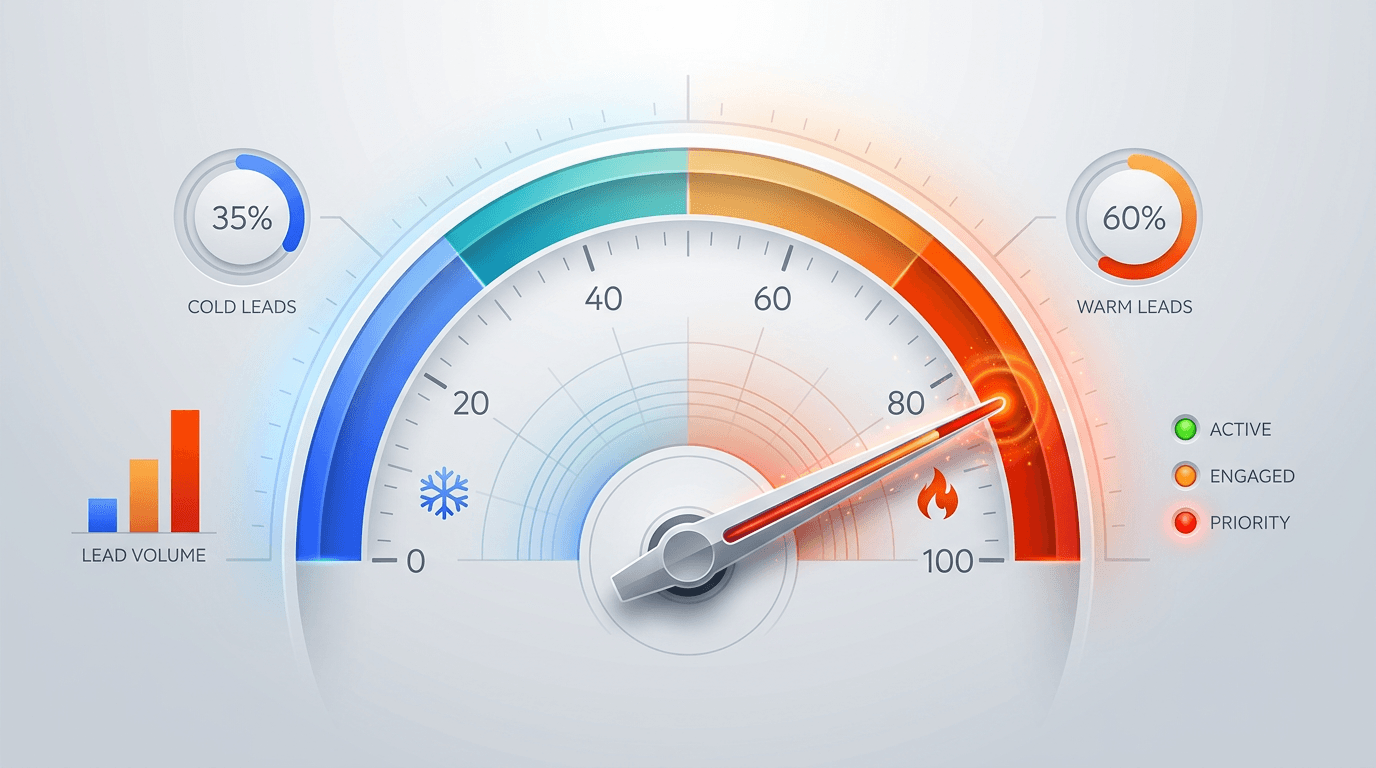
"What exactly is a hot lead?" "How is it different from a warm lead or cold lead?" "How do we judge the right moment to hand a lead off to sales?" When marketing and sales teams have misaligned views on prospect temperature, the cost is real: leads you carefully nurtured slip through the cracks, and sales resources get spent on prospects who aren't ready. A hot lead is a prospect whose purchase intent has risen to the point where a near-term opportunity and close are realistic—the centerpiece of the marketing-to-sales handoff in B2B.
This article systematically covers hot lead definitions, the differences between hot, warm, and cold leads, the major frameworks for identifying them (scoring, BANT, MEDDIC), the behavioral signals that mark hot leads, stage-by-stage nurturing approaches, lead qualification process design, common failure modes and countermeasures, and integration with measurement, MMM, and attribution analysis. If you're searching for "hot lead" or "lead qualification," use this as a practical guide for designing and improving your prospect management—whether you're in marketing, inside sales, sales operations, or executive leadership.
What is a Hot Lead? A Prospect with Elevated Purchase Intent
While "hot lead" is a term used routinely in the field, the working definition is often unclear even within a single company. Let's start with the basic meaning and how it sits relative to related terms.
Definition of a Hot Lead
A hot lead is a prospect with strong interest in your product or service, advancing through the evaluation phase, where a near-term opportunity and close are realistic. Common synonyms include "high-confidence lead" or "high-temperature lead." Among the leads marketing has acquired, hot leads are the ones judged—based on behavior, attributes, and timing—as having a high probability of converting to opportunities right now, and they're prioritized for handoff to field sales or inside sales. Identifying hot leads correctly is decisive in maximizing limited sales capacity and lifting both opportunity rates and close rates.
Why Hot Lead Identification Matters
Not every lead in the sales organization's database is close to becoming an opportunity or closing. The purchase intent of someone who exchanged a business card at a trade show, someone who downloaded a single useful resource, and someone who has visited the pricing page repeatedly to verify costs is fundamentally different. If sales applies the same effort to all of them, the resources available for the leads actually close to converting get diluted, leading to missed opportunity. Surfacing hot leads and prioritizing them lets sales focus on the highest-probability accounts, which dramatically increases productivity per opportunity. At the same time, lower-temperature leads are routed back to the marketing team's nurturing program, ready to be re-engaged once they warm up—and the division of labor starts running smoothly.
How Hot Leads Relate to Lead Nurturing and Lead Qualification
A hot lead represents the final stage in the demand generation process of B2B marketing. The standard funnel runs as follows: lead generation (acquiring prospects) → lead nurturing (developing prospects) → lead qualification (selecting prospects) → handoff of hot leads to sales → opportunity and close. Lead qualification is the activity of "determining which leads in your database qualify as hot leads," and a hot lead is what gets surfaced as the result of that selection. To increase hot lead volume, both wheels need to be turning—nurturing to warm prospects up, and qualification to judge them accurately.
Differences Between Hot, Warm, and Cold Leads
Prospect temperature is generally classified into three stages: hot, warm, and cold. Understanding the characteristics and the boundaries between them lets you decide both the priority of activities and the nature of outreach.
Cold Lead | Has a Touchpoint, but Little Active Interest
A cold lead has only vague awareness of your company or product, or has had a single past touchpoint—a newsletter signup, a one-time download—but currently shows no concrete interest or purchase intent. Typical examples include trade show contacts who only exchanged a business card, prospects who downloaded a free white paper just once, and webinar registrants who never actually attended. Direct sales outreach has a low probability of converting these leads, and pushing too hard with calls or email blasts can actually backfire. The standard approach for cold leads is mass-style nurturing—newsletters, content publishing, social media—to maintain touchpoints and wait for their problems to surface. They form the largest pool by volume and the foundational starting point for all nurturing programs.
Warm Lead | Interest Emerging, Evaluation Beginning
A warm lead has emerging interest in your product or service and has actively started gathering information and comparing options to solve a problem. Typical signals include continuously downloading multiple white papers, repeatedly attending webinars, viewing specific product pages multiple times, and high open and click rates on your newsletters. Even though purchase is still ahead, this segment has a high likelihood of being on the consideration shortlist, and with appropriate ongoing information delivery, they have a real chance of being promoted to hot leads. Effective tactics for warm leads include continuously delivering deeper, evaluation-stage content (case studies, selection guides, comparison resources) and using problem-deepening inside sales conversations to help articulate concrete needs.
Hot Lead | Purchase Intent Made Visible
A hot lead is a prospect whose purchase intent has surfaced—they're advancing concrete vendor selection toward a near-term decision. Strong signals appear: submitting a detailed inquiry through your contact form, repeatedly viewing pricing or quote pages, requesting a demo or signing up for a free trial, downloading a comparison resource against a competitor, or contacts coming directly from someone with decision authority. Once a lead has heated up to this level, the priority is rapid handoff to field sales for human-led discovery and proposal that converts the opportunity. Because delay in following up sharply increases the risk of losing to a competitor in the evaluation, many companies codify a "24–48 hour follow-up" as internal policy.
Three Axes for Distinguishing the Categories | Attributes, Behavior, Timing
Judging cold/warm/hot boundaries by gut feel—"this one feels hot"—creates inconsistency between judges and destroys reproducibility. The field-tested approach combines three axes: attributes, behavior, and timing—judging as quantitatively as possible. Attributes are fixed prospect information like company size, industry, role, and department; behavior is concrete actions like site visits, downloads, email opens, and webinar attendance; timing is purchase-affecting context like budget cycles, evaluation start, and contract renewal. Judging temperature with a combined score or checklist across these three axes removes dependence on individual judgment and produces a consistent organization-wide operation.
Major Frameworks for Identifying Hot Leads
To identify hot leads quantitatively, several standard frameworks are widely used in the field. Knowing scoring, BANT, and MEDDIC (MEDDPICC) gives you the foundation for designing your own qualification criteria.
Scoring | Combining Attribute and Behavior Scores
Lead scoring is the mechanism of assigning attribute scores and behavior scores to leads, with totals exceeding a threshold being surfaced as hot leads. Attribute scores assign points to leads with desirable characteristics—"industry matches our target: +10," "company size 500+ employees: +15," "role at director level or above: +10"—rewarding fit. Behavior scores assign points to actions signaling purchase intent—"resource download: +5," "webinar attendance: +10," "pricing page visit: +15," "contact form submission: +30." Marketing automation (MA) tools execute scoring automatically and notify sales when a lead crosses the threshold. Scoring isn't a silver bullet—getting the numbers right from day one is hard—so coefficients should be revisited regularly against actual opportunity and loss data.
BANT | The Classic B2B Sales Framework
BANT stands for Budget, Authority, Needs, and Timeline—a classic B2B sales qualification framework. Reportedly developed by IBM in the 1960s, it has been used in sales for over half a century. A lead meeting all four BANT criteria is judged as "a hot lead worth pursuing" and handed to sales. For example, a lead with "budget around $10,000 secured," "line manager has decision authority and can decide in next-period budget," "clear pain with current systems," and "intent to implement within six months" is a textbook hot lead meeting BANT at a high level. Critics point out that BANT's assumptions (budget-first, single decision-maker) don't fit modern B2B buying, but its simplicity and accessibility keep it a useful first-pass qualification axis.
MEDDIC and MEDDPICC | Evolved Frameworks for Complex Buying
MEDDIC stands for Metrics, Economic Buyer, Decision Criteria, Decision Process, Identify Pain, and Champion—a higher-precision qualification framework. Developed at PTC in the 1990s, it's widely adopted for complex enterprise B2B sales. Compared to BANT, it explicitly addresses identifying the economic buyer, mapping evaluation criteria and timeline, and finding an internal champion who can advocate for you. The evolved MEDDPICC adds Paper Process (contracting workflow) and Competition, allowing more precise risk management throughout the buying process. If scoring is "mechanical judgment based on behavior data," MEDDIC/MEDDPICC is "qualitative judgment based on inside sales and field sales discovery"—and combining the two significantly improves qualification accuracy.
Designing the Lead Qualification Process
Lead qualification is the end-to-end process of evaluating leads in your database to separate "hot leads to hand to sales" from "leads to return to marketing nurturing." The standard design starts with automated MA scoring as a first-pass filter; leads above the threshold are interviewed by inside sales to confirm whether they meet BANT or MEDDIC criteria. If they do, they're handed to field sales as SQLs (Sales Qualified Leads); if not, they go back to the marketing nurturing program for continued follow-up. The critical step is having marketing and sales agree on definitions of MQL (Marketing Qualified Lead) and SQL, then codifying them as an SLA (service-level agreement). Shared definitions and clear handoff rules are the foundation of high-quality hot lead operations.
Signals for Identifying Hot Leads
Knowing the frameworks isn't enough—the operational key is which behavioral signals you treat as "hot" indicators in practice. Below are the main signals available through MA tools and site analytics.
Signal 1: Repeated Visits to Product and Pricing Pages
Repeated visits to product, pricing, or feature comparison pages are strong signals that purchase evaluation is advancing. Pricing pages especially tie directly to purchase decisions, so leads viewing them multiple times are likely in the budget evaluation phase. The standard play is configuring MA conditions like "viewed pricing page 3+ times in last 30 days" or "compared multiple product pages in a single session," and auto-flagging matching leads as hot lead candidates. Combining context like "viewing during business hours on weekdays" or "viewing from a corporate IP address" further raises confidence that this is a buying-process evaluation.
Signal 2: Downloads of Comparisons, Case Studies, and ROI Templates
Leads downloading evaluation-stage content—comparison resources, industry case studies, ROI calculators, selection checklists—are likely advancing concrete vendor selection internally. Reading same-industry case studies suggests they're seriously considering your product as a solution to similar challenges. Using an ROI template indicates they're preparing internal business cases—one step before the approval process. These leads warrant high scoring weight and quick inside sales follow-up.
Signal 3: Inquiries, Demo Requests, and Free Trials
Contact form submissions, product demo requests, and free trial sign-ups are the clearest expressions of purchase intent. The lead has proactively initiated contact, putting them almost certainly in the hot lead category. Specific question content (pricing plans, implementation timeline, support, competitive differentiation) is even stronger evidence of advanced evaluation. With free trials, behavior data—login frequency, features used, number of users—reveals whether the evaluation is becoming organizational. Multiple users logging in or specific features being put to active business use are strong signals of serious implementation evaluation.
Signal 4: Touchpoints from Decision-Authority Roles
A lead's role and department are also important attribute data for judging hotness. The proximity to the decision process is fundamentally different between an individual contributor doing research and a director, VP, or executive directly downloading resources or submitting inquiries. When contact comes from someone with decision authority, the lead is likely already at internal budgeting or escalation stages and should be treated as an extremely high-priority hot lead. Conversely, when only junior team members are gathering information, internal evaluation often hasn't been formalized yet—rather than rushing sales onto them, continuing to deliver content and outreach that reaches decision-maker roles is more effective in advancing organizational evaluation.
Stage-Specific Nurturing Approaches
Each of the three temperature stages—hot, warm, and cold—calls for different nurturing approaches. Applying the wrong approach at the wrong stage creates real losses: "rushing cold leads with sales calls and damaging the relationship," or "sitting on hot leads too long and losing them to a competitor."
Cold Lead Cultivation | Sustained Touchpoints and Awareness
For cold leads, the top priority is "not being forgotten"—centering on programs that maintain regular information touchpoints. Monthly or bimonthly newsletters, industry trend content, invitations to free introductory webinars—these create a state where your company stays top of mind continuously. Calling cold leads with hard sales pitches or sending strong meeting-request CTAs only generates unsubscribes and aversion, and is counterproductive. Cold lead cultivation operates on a months-to-years timeline; the goal isn't short-term results but steady touchpoint maintenance, so that when their problem becomes acute, your company is the first one they think of.
Warm Lead Cultivation | Problem Deepening and Comparison Information
Warm leads have emerging interest and are in information-gathering mode, so deeper content and concrete examples that elevate intent toward hot status are most effective. Specific tactics include industry-specific and problem-specific case study collections, comparison and selection guides, ROI calculators, and expert-led explainer webinars. In parallel, lightweight discovery calls from inside sales (10–15 minutes) directly confirm evaluation status and needs. Leads identified here as "actively moving" are escalated to hot lead candidates, while leads identified as "not yet considering" are returned to the cold pool for long-term cultivation. The quality of information delivery and conversation at the warm stage largely determines the rate of promotion to hot.
Hot Lead Follow-Up | Rapid Handoff and Closing Support
For hot leads, fast and careful field sales follow-up is the top priority. Making first contact within 24–48 hours of an inquiry or demo request directly drives both opportunity rate and ultimate close rate. Many studies show that faster initial response correlates with significantly higher close rates, and response delay sharply increases the risk of losing the lead to a competitor. In field sales proposals, knowing the content the lead has previously viewed and resources they've downloaded—pulled from MA and CRM—lets you focus on the problems and evaluation criteria they care most about, dramatically improving opportunity rates. Beyond that, hands-on closing support that removes obstacles in the final purchase phase—pricing negotiation, contract paperwork, internal approval—is also a key driver of close rates.
Common Failure Patterns in Hot Lead Operations and Their Countermeasures
Hot lead operations are difficult to design and implement well, and many failure patterns appear in the field. Here are four representative failures and the countermeasures for each.
Failure 1: Vague, Person-Dependent Hot Lead Criteria
The most common failure is when "is this a hot lead?" depends on individual judgment. If marketer A thinks "viewing the pricing page makes it hot" while marketer B thinks "only an inquiry counts as hot," qualification criteria fragment within the same company. Sales accumulates frustration, citing "inconsistent lead quality from marketing." The countermeasure is documenting scoring rules, BANT criteria, and MEDDIC checklists as an official internal "hot lead definition document." The document should specify attribute and behavior scoring rules, thresholds, and the inside sales verification items required before handoff—creating a state where anyone reading it makes the same judgment. Building in a semi-annual review cycle that revises the document based on actual performance data continuously raises operational quality.
Failure 2: Marketing-Sales Misalignment Breaks the Handoff
The next most common failure is marketing flagging hot leads and handing them to sales, only to have sales push back—"this isn't hot"—or leave them unfollowed. The root cause is that the two functions don't share definitions of "what is a hot lead" or "who is responsible for follow-up after handoff." The countermeasure is having marketing and sales jointly author the definition document, codified as an SLA covering marketing's hot lead volume target and sales' follow-up response responsibility. Always log feedback in SFA or MA on whether handed-off leads converted to opportunities, and run a monthly joint review meeting between the two functions. With the feedback loop in place, qualification criteria continuously improve from real outcome data, and trust between the two teams strengthens over time.
Failure 3: Slow Follow-Up Causes Lost Opportunities
When sales follow-up on flagged hot leads is delayed by days or even a week, the risk of losing to a competitor rises sharply. Many studies report that leads contacted within 5 minutes have substantially higher conversion rates than those contacted later, and SLAs of "within 24 hours" or "within 48 hours" have effectively become industry standards. The countermeasure is automating notifications from MA to sales—real-time assignment to the responsible rep via Slack or email. In parallel, design rules for after-hours and weekend response, plus a backup structure for when the primary rep is unavailable. Speed of response should be guaranteed by the system, not by individual hustle—relying on the latter creates dependency and missed opportunities.
Failure 4: Excessive or Outdated Scoring
Another frequent failure is scoring rules that grew so complex no one can maintain them, or rules that haven't been updated in years and run on obsolete criteria. Tiny incremental rules—"email open: +1," "site visit: +0.5"—stack up so that fundamentally low-temperature leads end up flagged as hot. The countermeasure is keeping scoring simple and limiting yourself to about 10–15 scoring criteria. Semi-annually, validate each scoring criterion against actual opportunity and loss data—did it actually predict accurately?—and prune or adjust criteria that don't contribute. Scoring isn't "set and forget"—the operational mindset of "raise it and keep raising its precision" is what makes scoring successful.
Integrating Hot Lead Operations with Measurement and Data Analysis
To translate hot lead operations into business decisions, visualizing performance with full-funnel KPIs and integrating with adjacent marketing analysis disciplines is essential.
Core KPIs | MQL, SQL, SAL Rate, Opportunity Rate, Close Rate
Representative KPIs for measuring hot lead operations quality are MQL count (leads marketing has qualified), SQL count (leads sales has accepted), SAL rate (MQL-to-SQL conversion), opportunity rate, and close rate. A low SAL rate indicates misalignment between marketing and sales on hot lead definition; a low opportunity rate indicates insufficient temperature judgment; a low close rate indicates issues at the proposal or closing stage—each pinpointing where improvement is needed. Average revenue per hot lead (ARPL) and lead time to close (average days from MQL qualification to close) are also important operational efficiency metrics. Auto-aggregating these from MA, CRM, and SFA into dashboards and reporting them monthly and quarterly to leadership embeds hot lead operations into executive decision-making.
Integrating MA, CRM, SFA, and Data Infrastructure
Hot lead identification and handoff only work when MA, CRM, and SFA—three tools—operate in concert. MA captures lead behavior data and runs scoring, CRM unifies and deduplicates customer information, and SFA manages the opportunity-to-close pipeline—the standard division of labor. When these three systems are disconnected, blind spots emerge: "can't tell if marketing's leads converted to opportunities," "can't feed loss reasons back into nurturing." The integration design hinges on standardizing lead unique keys (email, phone, ID) and pushing opportunity and close outcomes back into MA to create a scoring improvement loop. With cookie deprecation underway, the standard is moving toward unified data infrastructure (CDPs) centered on first-party data, with privacy-aware lead information management.
Contribution Measurement via Attribution Analysis and MMM
To evaluate which programs and channels are generating hot leads, attribution analysis and marketing mix modeling (MMM) come into play. Attribution analysis evaluates the touchpoints leading to a conversion (becoming a hot lead, or closing), revealing how SEO, paid media, email, and webinars contribute as first touch, assist, and last touch. MMM is a statistical method estimating channel contribution from historical channel-level spend and revenue data, drawing renewed attention because it can evaluate programs without identifying individuals—important under cookie deprecation. Last-click measurement alone tends to overweight the channel that generated the final form submission; making multi-touch contribution visible through attribution and MMM correctly credits the upstream nurturing programs that fed hot lead conversion, supporting cross-organization investment optimization.
Lead Qualification Infrastructure for the Privacy Era
Under intensifying cookie regulation and privacy protection in 2026, the data infrastructure underlying hot lead identification needs redesign. The shift away from cross-site tracking via third-party cookies toward first-party data collected directly by your company—form submissions, email engagement, site behavior, webinar attendance—is now the standard. Server-side tagging, conversion APIs (CAPI), and customer data platforms (CDPs) let you capture behavior data stably without depending on browser constraints, maintaining and improving hot lead qualification accuracy. Coordinating across marketing, legal, IT, and data teams—designing privacy policy, consent flows, and data retention policy holistically—is the foundation for a sustainable hot lead operation.
Summary | Hot Lead Accuracy Hinges on Shared Definitions and Data Operations
A hot lead is a prospect whose purchase intent has risen to the point where a near-term opportunity and close are realistic. Correctly understanding the three-stage distinction—cold (touchpoint exists but interest is thin), warm (interest emerging, evaluation beginning), hot (purchase intent visible)—and designing nurturing and follow-up tailored to each is the key to maximizing limited sales capacity.
Identification leverages frameworks like lead scoring (combining attribute and behavior scores), BANT (Budget, Authority, Needs, Timeline), and MEDDIC/MEDDPICC. Combining mechanical judgment via scoring with qualitative judgment via inside sales discovery substantially raises accuracy. Quantitatively capturing signals like repeated pricing-page visits, comparison and case study downloads, demo requests, and contact from decision-authority roles is what builds a system for accurately surfacing hot leads.
Common failure patterns in the field—vague criteria, marketing-sales misalignment, slow follow-up, scoring obsolescence—are all preventable through operational discipline: documenting definitions, setting SLAs, automating notifications, and reviewing scoring semi-annually. Visualizing performance through funnel KPIs (MQL, SQL, SAL rate, opportunity rate, close rate), integrating MA, CRM, and SFA, and operating the entire lead qualification process as an organization—this is what evolves hot leads from "a sales gut feel" into "a data-backed system."
Under the cookie deprecation environment of 2026, the prerequisites for sustainable hot lead operations are first-party data infrastructure and multi-touch contribution measurement via attribution analysis and marketing mix modeling (MMM). NeX-Ray provides the expertise and technology in ad measurement, MMM, and attribution analysis to evaluate the contribution of all marketing programs—including hot lead conversion and lead qualification—in an integrated way. Move from "hot lead judgment based on sales intuition" to "hot lead operations provable with data." Use this article as the starting point for elevating your prospect management to its next stage.