
What Is Native Advertising? Types, Benefits, and Success Cases
May 9, 2026
Author: Shusaku Yosa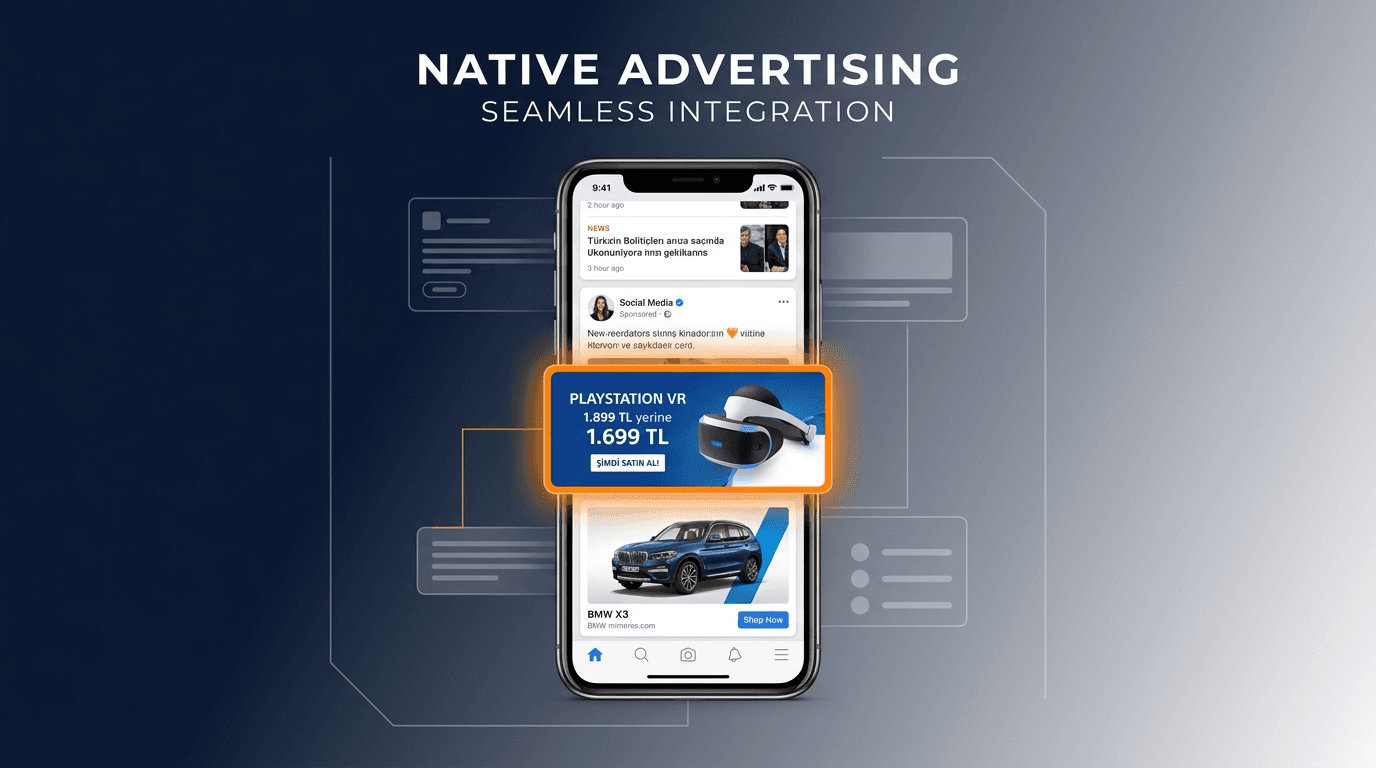
If you spend any time on web media or social, you've probably noticed more and more ads that blend naturally into the articles and posts around them. That's native advertising. Unlike banner ads with their unmistakably commercial look, native ads run in the same design and tone as the surrounding media content — so they reach the reader without breaking the flow of what they were already doing.
At the same time, you'll often hear practitioners say things like: "There are so many types — I don't know which to pick," "I'm worried we'll get mistaken for stealth marketing," or "I can't get a clear read on the timeline or how to evaluate results." This article walks through what native advertising actually is and the three conditions IAB lays out, the six representative types, the upsides and the downsides, the major distribution channels and success cases, how to design operations and KPIs, and how native ads differ from stealth marketing along with the legal points to watch — all from a working web-advertising perspective. It's written for both teams just starting out with native ads and teams already running them but not seeing the returns they expected.
What Is Native Advertising | Definition and Core Concept
The Definition
Native advertising is the umbrella term for paid placements designed to blend naturally into the content of a web property or app. They run in the same design, format, and position as the host media's articles, posts, search results, or recommendation slots, so the reader receives them in the same way they consume everything else on the page. The word "native" carries the sense of "originally part of the place / belonging there," and that's exactly what the format does — it sits natively inside the media environment.
What's important to understand is that native advertising isn't a single ad format — it's a family of formats that share a common design philosophy. SNS in-feed posts, ads tucked into a news app's article list, listing ads on a search results page, sponsored items in an EC site's recommendation rail — all of these qualify as native advertising. The unifying idea is to respect the user's experience of the media and deliver the message as part of the content rather than on top of it. That's the deep break with banner ads and pop-ups.
The Three Conditions Set by IAB
Looking like the surrounding content isn't enough. The IAB (Interactive Advertising Bureau), the US online advertising industry body, lays out three conditions a native ad must meet in its Native Advertising Playbook. First, Form — the ad uses the same design and format as the rest of the host media's content. Second, Function — the ad behaves the same way the surrounding content does. For instance, clicking takes the user to a detail page, just as it would for any organic article on the page.
Third, Disclosure — it must be clearly indicated to the user that the placement is an ad. Labels like "Ad," "PR," "Sponsored," or "Promoted" are required, and the user must not be misled about what they're looking at. Of these three, the third — Disclosure — is the one to watch. Precisely because native ads visually resemble the surrounding content, the explicit "this is an ad" signal is the lifeline of transparency. Drop it, and you can no longer be cleanly distinguished from stealth marketing — which exposes you to the legal risks under Japan's Act against Unjustifiable Premiums and Misleading Representations covered later in this article.
Native Ads vs. Banner Ads, Tie-Up Articles, and Content Marketing
Native ads get confused with three neighboring concepts: banner ads, tie-up articles, and content marketing. Banner ads are the traditional display format — image or text creatives delivered into fixed ad slots on a website, visually distinct from the surrounding content. They make impression and click data easy to track, but their "obviously an ad" appearance has been hurting click-through rates for years now.
Tie-up articles are article-format ads produced in collaboration with a media outlet's editorial team, and they sit inside the native advertising family. Content marketing, on the other hand, is the broader practice of publishing useful information on your own owned media to grow organic search and direct traffic, and ultimately leads and fans — the core idea is sustained, company-led publishing across whichever channels work. Native ads are paid distribution into external media; content marketing is unpaid distribution from your own. The two complement each other, and in practice the standard play is to amplify content-marketing assets — articles or whitepapers — through native ads.
The Six Types of Native Advertising
In-Feed Ads | The Mainstream Format That Blends Into the Timeline
In-feed ads are the most common form of native advertising. They appear in the flow of a feed — SNS timelines, news app article lists, recommendation rails on video platforms — in the same shape as the regular content. X, Meta (Facebook and Instagram), TikTok, LINE, SmartNews, Yahoo! News, Gunosy — the dominant in-feed slots on the platforms where users spend their time all run this format. Apart from the "PR," "Ad," or "Sponsored" label, the placements look identical to organic posts, which is why they pull eyes and produce higher CTRs.
The strengths are clear: enormous reach, rich targeting on age, gender, and interest, and full-fidelity reporting from each ad platform. The flip side is that users who clicked thinking it was content tend to bounce the moment they realize it was an ad — so the quality of the LP or the content they land on largely decides whether the campaign works. Some platforms are also strict about exaggerated claims, so refining the copy and rotating creative regularly are non-negotiable parts of running this format well.
Paid Search | Listing Ads on Search Engines
Paid search ads run on search engine results pages — Google Ads and Yahoo! Ads listing ads (search-keyword-triggered ads) are the canonical example. They appear at the top or bottom of the results in a format that closely mirrors the organic listings, marked with "Sponsored" or "Ad." By IAB's definition, paid search counts as a type of native advertising too.
Where in-feed shines on reaching latent demand, paid search is built for users with explicit intent. They land in front of someone actively searching for a fix to a problem, which is why CVR runs high and the analytics are tight. The catch is that competitive keywords have steadily expensive CPCs — the auction model means popular terms turn into a war of attrition with your competitors. Combining latent-demand acquisition through in-feed with explicit-demand harvesting through paid search to cover the full funnel is the modern web advertising playbook.
Recommendation Widget | The "Suggested Articles" Slot Below the Article
Recommendation widgets are the "recommended articles" or "you might also like" slots you'll find under articles on news and information sites. The system serves placements based on the user's reading history and the article they just finished, with platforms like Outbrain, Taboola, and Popin running the major networks. They sit toward the bottom of the page so they get fewer eyes than other formats, but they reach a particular kind of user — someone who's just finished an article and is still hungry for more — which makes them well-suited for capturing high-intent attention.
Recommendation widgets give you broad network reach in a single buy and sharp interest-based targeting. The trade-off is that you can't fully control which sites your ads land on, so brand safety — making sure your placements don't end up next to content that conflicts with your brand — becomes ongoing work. Using the platform's blocklist features and auditing the placement reports continuously is the operational baseline.
Promoted Listings | Top-of-Search Placements Inside EC Sites
Promoted listings appear as "sponsored" slots at the top of internal search results on EC and review sites. Amazon Sponsored Products, Rakuten's RPP ads, and the top-of-list placements on Gurunavi or Tabelog are the canonical examples. When a user searches by product name, category, or location, the placement appears alongside the regular results in identical formatting, marked "Sponsored." The pattern resembles search-engine listing ads, but the post-click destination is a product or store page within the same platform.
On EC, promoted listings are a powerhouse for reaching users at peak purchase intent. Top-of-search placement on Amazon makes a sharp difference to revenue, which is why everyone from national brands down to D2C and small EC shops uses them. The continuing tension is rising bid prices and intensifying intra-category competition — to win, you have to optimize the product page (title, imagery, reviews, price) and the ad operations together, not in isolation.
In-Ad (with Native Elements)
In-ad placements are ads that run in the regular ad slots outside an article's body, but with creative that's contextually related to the page's topic. The display format is banner-style, but because the surrounding content shares a theme with the placement, IAB still files this under native advertising. A classic example: a banner for an AI support tool running next to an article about AI.
Because the format is banner-style, you get fixed ad slots and clean reporting on impressions, but users recognize them as ads and CTRs run lower than for in-feed. The lever that decides whether the format works is creative craft — image and copy that speak directly to the article's topic — and the match between the host media's reader profile and the ad message is what produces results.
Custom | Media-Specific Formats
Custom formats cover everything that doesn't fit the five categories above — placements built around a single platform's unique format. LINE Promotional Stamps (official LINE stamps a company creates as advertising), Spotify's digital audio ads, in-game brand experiences, large-scale tie-up articles co-developed with a media outlet — all of these sit here. They feel less like "advertising" and more like a brand experience or a piece of content the user opts into, building brand value through experiences the user actually wants to engage with.
The appeal of custom formats is that you get to express the brand experientially, with secondary reach through fan engagement and SNS sharing on top. The trade-offs are higher production cost and longer timelines than the other formats, plus measurement that runs more indirectly. The realistic placement is at the core of awareness or branding programs, with lead-generation and direct-response KPIs handled by other formats. As AI, AR, and VR mature, this is also the area with the most room to grow as a discipline.
The Benefits of Native Advertising
Doesn't Disrupt the User Experience and Lands More Easily
The single biggest benefit of native advertising is that it reaches the user without breaking their flow. Banner and pop-up ads tend to interrupt reading or cover the screen, which generates real friction. The rise of ad blockers and the long-running decline in banner CTRs both point back to that same bad experience. Native ads, on the other hand, run inside the flow of the content — readers encounter them without that jolt of "oh, an ad" and as a result are far less likely to develop the active aversion that banners produce.
Respecting the user's experience pays off in long-term brand value too. "That company's ads are noisy" or "I keep getting hit with their annoying ads" — those negative impressions drag down purchase intent and degrade word-of-mouth. Building up brand recognition through native advertising as "a company that delivers genuinely useful information" is particularly powerful for B2B products with long consideration cycles and for higher-priced consumer products.
Broad Reach Into Latent Demand
The other big strength is reaching latent demand — users who don't yet know your service exists. Search-keyword ads target users who are already trying to solve a problem, but native ads (especially in-feed and recommendation widgets) reach a much wider audience inside the content they're already consuming. Baby-care products on a parenting site, a B2B SaaS ad on a business publication, a kitchen-appliance ad on a cooking site — that kind of placement plants seeds with people who are interested in the space but aren't yet shopping for a specific product.
Reaching latent demand is what cultivates "future customers" you'd otherwise miss with a search-only program. Native-ad awareness today makes you the brand someone recalls when they actually develop the need, which lifts branded search and direct visits down the line. Over the medium term it ripples into search-ad costs too — if branded search is closing CVs reliably, you're less exposed to CPC inflation on generic keywords. The standard model is upper-funnel native ads paired with lower-funnel search ads, with budget split across the two.
Higher Click-Through and Engagement
Native ads consistently produce higher CTRs than standard banner ads because they run as part of the content. Without an aggressive "this is an ad" presentation, the user's psychological guard drops, and their eyes naturally rest on the placement as something potentially interesting. On SNS in-feed, you also pick up likes, shares, and comments just like on organic posts — which means real secondary reach from spread that you didn't pay for.
The fit with mobile is another strength. Smartphone screens fit less on a single view than desktop, so fixed ad slots are easier to miss — but native ads sitting in the feed flow pass through the user's view on every scroll, which means you actually reach them on mobile. With most web-ad traffic now coming from smartphones, that's a decisive advantage.
Drawbacks and Watch-Outs
Results Take Time
One drawback worth knowing up front is that conversions can take a while to show up. Unlike listing ads, which harvest explicit demand, in-feed and recommendation widgets focus on latent demand — the first touch rarely produces a purchase or inquiry on its own. The right framing is treating native ads as one stage in a step-by-step funnel: awareness → interest → consideration → purchase.
The countermeasure that matters most is not evaluating KPIs on direct CV alone. Looking at the immediate post-launch CV count and concluding "this isn't working" — then pulling the plug — costs you the awareness asset that was actually building. Set up the measurement framework from day one to also include indirect signals: assisted CV (touchpoints before the final CV), changes in branded search volume, direct site visits, the size of your retargeting audience. Operating on a 3- to 6-month evaluation cadence is something every team that gets results from native advertising has in common.
Heavy Creative Production Workload
Native ads need creative tailored to each platform's format, audience, and tone, so the production load runs higher than for standard banner ads. Even for the same product, the winning formula varies completely — short text and image on X, visual-led on Instagram, vertical video on TikTok, article-style copy on SmartNews, image plus headline on a recommendation widget. To get the most out of any of these, you have to keep feeding new variations into the platform with A/B testing as the operating mode.
The countermeasure starts at launch — building "creative production at volume" into the operational plan from day one. Teams with in-house creative resources standardize per-platform templates and operating rules; teams that can't fully cover production internally bring in agencies or freelancers who specialize in creative. Once campaigns are live, watching for fatigue (rising frequency, falling CTR) in each platform's reporting and rotating creative every two to four weeks is what holds performance steady on long-running campaigns.
Misclicks, Bounces, and Brand Damage
The same property that makes native ads blend into content carries a real risk — users mistake them for regular content, click, and then bounce or push back the moment they realize it was an ad. You can squeeze out short-term clicks with exaggerated claims or bait-style thumbnails, but if the destination doesn't deliver against the user's expectations, bounce rates spike and the damage rolls back to the brand as distrust. Headlines like "People who do X should be careful" or "The shocking truth" are a textbook case — they pull CTR but degrade CVR and brand metrics in lockstep.
The countermeasure is putting "expectation matches reality" first, ahead of click-bait. Whatever the ad copy promises, the LP or article on the other side of the click has to actually deliver — design for not betraying the reader's expectation. Brand safety on the host media also matters: keep an eye on the platform's blocklist features and the campaign reports so your placements don't end up next to content that misaligns with your brand.
Major Distribution Media
SNS | Meta, X, LINE, TikTok
The major SNS platforms are Meta (Facebook and Instagram), X, LINE, and TikTok. Meta offers rich targeting on age, gender, interest, and occupation, and gets used widely across both B2B and B2C. Instagram is visual-led and especially strong on reaching younger female purchase audiences; X plays well for real-time messaging to information-hungry users. LINE is the standout in Japan for sheer user base and near-push-notification reach, which makes it powerful for consumer products. TikTok has a different shape — short-form video culture means explosive reach into Gen Z and younger demographics, and it works particularly well for emerging brands and products that benefit from video storytelling.
SNS ads work for B2B too. Facebook in particular supports targeting by job title, industry, and company size, giving you direct access to decision-makers. LinkedIn Ads doesn't have the scale in Japan that it does in the US or Europe, but its presence is growing fast in enterprise marketing and employer branding. The principle for picking SNS platforms is straightforward: go where your target audience actually spends time, run several in parallel, and keep comparing channel performance over time.
News and Curation | SmartNews, Yahoo!, Gunosy
On the news and curation side, SmartNews, Yahoo! News, Gunosy, and NewsPicks are the major native-ad slots. They run in-feed placements with a "Sponsored" label inside the article list, reaching the broad swath of users who consume news habitually. SmartNews skews toward information-aware users in their 20s through 40s, Yahoo! News delivers Japan's largest-scale reach across a broad demographic, and Gunosy is the right fit when you need concentrated delivery to users with strong interest in a specific genre.
On these platforms, your creative is sitting next to a news headline and thumbnail — so editorial-toned copy and photography do the heavy lifting on CTR. Information-value framings work well: breaking news, explainers, comparisons, checklists. Pure sales copy gets ignored. In B2B, the pattern that's gained traction is pairing native ads with industry-trend explainers or research-report intros, giving the placement a dual role of awareness plus content traffic.
Recommendation Widgets | Outbrain, Taboola, Popin
The major platforms in the recommendation-widget space are Outbrain, Taboola, and Popin. They run networks that place ads inside the "recommended articles" rails under articles on major media properties, which lets you reach a large set of media in a single buy. The traffic is users who've just finished an article and want more, so it skews toward content-hungry audiences and pairs naturally with long-read LPs like whitepapers and case-study collections.
You can't fully control where your placements land, so blocklist management for brand safety becomes a standing operational task. Once you're live, audit the actual placements through the reporting view and progressively block media that don't fit your brand — that's how you keep distribution quality up. CPCs often run lower than on SNS, which means recommendation widgets are a strong fit for awareness work and traffic into long-read LPs, with healthy cost efficiency.
Search and EC | Google, Yahoo!, Amazon, Rakuten
On the search and EC side, Google and Yahoo! listing ads (paid search) and Amazon and Rakuten promoted listings both fall under native advertising. Search is direct outreach to high-intent users and serves as the workhorse for direct-response programs. Google in particular has been pushing automated cross-surface products like P-MAX (Performance Max) — a single campaign that runs across Search, Display, YouTube, Discover, and Gmail — and many advertisers are using its native formats inside that.
Promoted listings on EC platforms center on Amazon Ads' Sponsored Products and Sponsored Brands, and on Rakuten's RPP ads. They're indispensable as the harvesting channel for users at peak in-mall purchase intent — the rule is to run them in lockstep with product page optimization. For the same product, awareness comes from SNS and news platforms while harvesting comes from search and EC. Splitting the roles and laying out budget across the full funnel is the modern web advertising playbook.
Patterns That Work — Lessons From Success Cases
B2B SaaS | Tie-Up Articles × Whitepapers Driving Sales Conversations
A frequent winning pattern for B2B SaaS companies is pairing tie-up articles on industry media with whitepaper distribution. You run a tie-up on a marketing-industry publication, lay out the problem-solving framework carefully in the body, then route from the article footer to your whitepaper or seminar. If the article actually delivers value to the reader, downloads follow, and from there email nurturing into an inside-sales call generates the funnel that produces sales conversations.
What makes this pattern work is not chasing CV from the tie-up article alone — it's setting up the full chain from day one: "awareness → whitepaper download → nurturing → sales conversation." The KPIs on the tie-up article stay on article reach, read-through rate, and LP click-through, with CV evaluation handled across the full funnel below. Tie-up article → Facebook retargeting → branded-search harvesting via paid search — that kind of multi-channel chain is the standard play for lifting sales-conversation rates from the floor up.
D2C and EC | SNS In-Feed × UGC-Style Creative
D2C brands and EC sellers have settled on a clear pattern: in-feed ads on Instagram and TikTok with UGC-style creative — placements with a tone close to user-generated content. Vertical videos shot from a real-user perspective, review-style text overlays, before-and-after comparisons — these slot into the feed alongside organic content with high affinity, which is what makes CTRs lift. The destination usually isn't the EC site directly but a layered set of LPs (review-article LP, subscription-signup LP, sample-kit application LP) routed by intent level, which lets you optimize CVR.
What makes or breaks this pattern is designing the work to feel "non-advertorial but compliant with Japan's Premiums and Representations Act and Pharmaceutical and Medical Device Act." Categories like cosmetics, health foods, and beauty devices have strict rules on efficacy claims, and dropping UGC-style copy in unedited tends to land you on the wrong side of those rules. The safe operating model is having the agency, your in-house legal counsel, and a Pharmaceutical and Medical Device Act advisor review the copy together. Pulling CTR with copy that tips into Pharmaceutical and Medical Device Act violations or stealth-marketing rule breaches risks administrative penalties and major brand damage — design compliance into the operating model from the start.
Large Brands | Custom Tie-Ups Delivering Brand Experience
For large brands, the work tends to center on custom formats — major tie-ups co-developed with media partners, LINE Promotional Stamps, brand-experience content on Spotify or YouTube. A beverage brand running an original playlist plus audio ads on a music streaming service, an automaker partnering with a news publication on a tie-up article around a new vehicle test drive — that's the shape of it.
Custom formats are KPI'd on brand awareness, brand favorability, and recall — not on lead generation or direct CV. Evaluation runs on a mix of quantitative and qualitative signals: post-campaign brand-lift studies (comparing exposed vs unexposed audiences), social listening for mention volume and sentiment, changes in branded search volume. Because the role is different from short-term CV-optimization formats, alignment on the evaluation framework has to happen inside your organization first — otherwise the campaign gets cut for "unclear ROI." Bringing executives and brand leadership into the conversation at the planning stage is what makes these programs durable.
Designing the Operation and the KPIs
KPIs by Funnel Stage
KPIs for native ads shift depending on which funnel stage you're targeting. Awareness stage (in-feed, recommendation widget, custom): impressions, reach, video completion rate, site visits, brand-lift signals. Interest and comparison stage (tie-up articles): article read-through rate, LP click-through rate, whitepaper downloads, newsletter signups, retargeting list size. Consideration and purchase stage (paid search, promoted listing, retargeting): CVR, CPA, ROAS, sales conversation count, deal revenue. Set the right metric for the right stage.
Trying to evaluate every format on the same CPA or ROAS bar guts your awareness-stage formats and shoves all the budget downstream — the classic doom loop. The fix is positioning each format's role inside the marketing journey design and splitting credit so you can evaluate contributions separately. Multi-touch evaluation that includes assisted CV, indirect CV, branded search lift, and direct site traffic — not just final CV — is what keeps native-advertising programs alive long enough to actually pay off.
Creative Operations and PDCA
Native advertising is a format where creative differences swing results dramatically. Ship multiple variations at launch (image, copy, video length), A/B test, and pick winners on CTR, CVR, and CPA. Once a winning pattern emerges, decompose its elements and generate new variations, then keep the test cycle running. Recording wins and losses by element — image composition and color palette, the subject and angle of the copy, how numbers get used, the verb on the CTA — turns isolated test results into accumulated team knowledge.
While campaigns are live, watch frequency (the number of times the same user has been served the ad). The higher frequency climbs, the more CTR drops, so rotating creative every two to four weeks to avoid fatigue has become standard practice. Build the operation so you catch fatigue signals early in the platform's reporting view and can deploy new creative quickly — that's the lever that holds long-running campaigns at performance. Don't outsource it to the agency entirely; participate in creative review cycles in-house too. That's what builds your team's understanding of each platform and lifts the precision of the next round.
Coordinating With Search Ads, SEO, and Other Channels
Native advertising shows its real value in coordination with other channels — search ads, SEO, email marketing, organic SNS — not on its own. Designs that pay off: native ads build the awareness, search ads catch the same audience when they later return on a branded search; native-ad LP visitors get added to a retargeting list and re-approached during the consideration phase; native-ad traffic combines with SEO articles to lift site-wide dwell time and return rate. The combinations are where the results live.
To see results across the integrated picture, surface per-channel contribution in your analytics tool (GA4 or equivalent) and connect through to CRM and MA so you can track all the way down to deal revenue. Looking at native-advertising CPA in isolation hides its "floor-raising" contribution to other channels and tends to undervalue the work, but assisted-CV analysis or marketing mix modeling (MMM) brings that real contribution back into view. Standing up the cross-channel evaluation infrastructure is the precondition for designing programs end-to-end from the top of the funnel down.
Differences From Stealth-Marketing Regulation and Legal Watch-Outs
How Native Advertising Differs From Stealth Marketing
Native advertising gets confused with stealth marketing all the time, but the two are clearly distinct. Native advertising is paid placement that blends into the host media's content format, and it always carries an explicit "Ad," "PR," or "Sponsored" label so the user knows what they're looking at. Stealth marketing is the opposite — recommending a product or service to consumers while concealing the fact that it's a paid placement. Reviews and word-of-mouth posts staged to look organic, celebrity or influencer endorsements where the paid relationship isn't disclosed — those are the textbook examples.
The decisive difference is whether the advertiser's role is disclosed. Native advertising is a legal advertising practice — discloses the placement is an ad, then takes on the host media's format. Stealth marketing misleads consumers from the moment the placement isn't disclosed as advertising, which puts it inside the regulated zone of Japan's Premiums and Representations Act, covered below. In practice, when designing native-ad creative, the discipline is checking at each stage — production, review, publication — that the PR label is in a position and size where the user can actually see it.
The Stealth-Marketing Rule Under Japan's Premiums and Representations Act
In Japan, a stealth-marketing rule under the Act against Unjustifiable Premiums and Misleading Representations took effect in October 2023 (a new designated notification under the Premiums and Representations Act). The rule treats any promotion run by a business without disclosure that it's advertising — specifically, presentations a general consumer can't distinguish from the business's own messaging — as misleading. Violations trigger administrative orders, with risks including company-name disclosure and surcharges. Influencer-paid posts, self-posted high-ratings reviews on review sites, third-party-style endorsement posts — all of these fall in scope.
Native advertising itself stays compliant if it carries clear disclosure that it's a paid placement (PR label or equivalent), but watch for the gray-area patterns: missing PR notation in influencer marketing, missing "product provided" disclosure on a sponsored review article, ambiguous advertising labeling on affiliate articles. Vague labeling tilts the work into stealth-marketing territory. The standard playbook is to set up internal labeling guidelines, run pre-launch legal review, monitor placements post-launch, and codify the influencer's labeling obligations in the contract — both operational and contractual measures.
Industry Guidelines and Implementing PR Disclosure
When implementing PR disclosure, the safe path is referencing the Consumer Affairs Agency's guidelines on the Premiums and Representations Act and the industry guidelines from JIAA (the Japan Interactive Advertising Association) and the WOM Marketing Council. The general implementation rules: place the labels — "PR," "Ad," "Sponsored," "Promoted," "Tie-Up" — in a size and position where the user can clearly see them; put the disclosure at the top of the content or somewhere unmistakable; for video, communicate the advertising nature through both audio and on-screen captions, not text alone.
Labeling rules vary subtly across host platforms, so document the per-platform guidelines for the major players (Meta, X, LINE, SmartNews, Outbrain, etc.) as internal knowledge — that cuts down on operational mistakes. Don't outsource compliance to the agency entirely. Periodic review by your in-house marketing team and your legal or compliance lead is the most reliable way to prevent both brand damage and administrative action. Stealth-marketing enforcement is expected to tighten further, so tracking guideline updates needs to live as an ongoing responsibility inside the marketing function.
Common Pitfalls in Native Advertising and How to Avoid Them
Evaluating on Short-Term CPA / ROAS and Pulling the Plug
The most common failure mode: looking at CPA or ROAS in the first one or two months after launch, deciding "this isn't working," and shutting down the awareness-focused native ad campaigns. In-feed and recommendation-widget formats focus on planting seeds in latent demand, so CPAs run high in the early stages. Pulling the plug there costs you the awareness asset that was actually building plus the branded-search stock you would have inherited from it — and you end up with a future where search-ad CPCs eat you alive.
The fix is splitting KPIs by funnel stage. Evaluate awareness-focused formats on reach, branded-search lift, direct site traffic, and assisted CV. Evaluate harvesting formats on CPA and ROAS. Separate the roles. Bake the 3- to 6-month medium-term evaluation cycle into the plan from day one and get an internal agreement on rules that prevent shut-downs based on short-term numbers. Once executive and marketing leadership sign off on the budget, your operators are insulated from the short-term-numbers pressure and can run for medium-term wins.
No Creative Production at Volume
The next most common pattern: running for weeks on the handful of creatives produced at launch, then watching CTR collapse and leaving everything in place. Native advertising is a format where creative differences swing results dramatically — without an A/B-and-rotation cycle, operations hit a wall fast. "The agency isn't shipping new creative," "Internal design resource isn't there to support rotation" — when those structural issues stay unresolved, the platform's reporting deteriorates and that's all you have to look at.
The fix is putting an operating plan in place at launch — "three to five new creatives every two to four weeks." Lock in internal design and copywriting capacity, and where it falls short, bring in agencies or freelancers strong on creative production. Run knowledge capture in parallel — record the winning patterns by platform — and three to six months out, you've built a proprietary reference table of "creative elements that win for us," with major lifts in operational efficiency and repeatability.
No Risk Management for Stealth Marketing, Pharmaceutical and Medical Device Act, or the Premiums and Representations Act
What teams overlook most often: the compliance regime around stealth-marketing rules, the Pharmaceutical and Medical Device Act, and the Premiums and Representations Act. While chasing CTR and CVR, exaggerated claims, ambiguous PR labeling, and efficacy-claim violations creep in, and the moment something goes viral on SNS, the brand takes the hit. PR-labeling misses on influencer programs, claim-rule violations on health foods or cosmetics, self-posted reviews leaking onto review sites — all of these tend to happen because "the team is racing to ship results."
The fix is putting three pieces in place from launch: a systematic pre-launch legal review, a documented labeling guideline, and codification of the influencer's and the agency's compliance obligations in the contract — plus monitoring after launch. In categories with strict claim regulation (cosmetics, health foods, etc.), the safe move is bringing in a Pharmaceutical and Medical Device Act advisor or legal counsel from the planning stage. "Speed marketing can move at" and "brand assets compliance protects" aren't actually a trade-off — bake the compliance work in early and you can run them in parallel.
Conclusion | Native Advertising Is Won on Channel Fit and Funnel Design
Native advertising is the mainstream web-ad format that delivers information without breaking the user's flow. The six types — in-feed, paid search, recommendation widget, promoted listing, in-ad, and custom — each take on a different funnel stage: awareness, interest, consideration, harvesting. The core of the work is combining the major media groups (SNS, news and curation, recommendation networks, search and EC) to match your target audience and consideration journey.
Producing results requires KPI design by funnel stage, creative production at volume with A/B testing, coordination with other channels (search ads, SEO, MA), and a compliance regime that handles stealth-marketing rules and industry-specific regulation. The pitfalls to avoid: evaluating on short-term CPA or ROAS and shutting down awareness-focused work, watching CTR collapse because there's no creative-rotation system, damaging the brand through inadequate PR labeling or compliance management. Sharpening operations on a 3- to 6-month medium-term evaluation cycle is the through-line of teams that succeed with native advertising.
What matters is not making "running native advertising" the goal in itself — it's positioning the work with a clear view: "In our overall marketing journey design, which funnel stage and which kind of customer touchpoint is this carrying?" Use this article as a starting point to redefine the role native advertising should play given your products, audiences, and full funnel, and then build the channel selection, creative, and KPI design end-to-end from that anchor.