How to Run a 3C Analysis: A Complete Guide with Examples and Templates
May 1, 2026
Author: Shusaku Yosa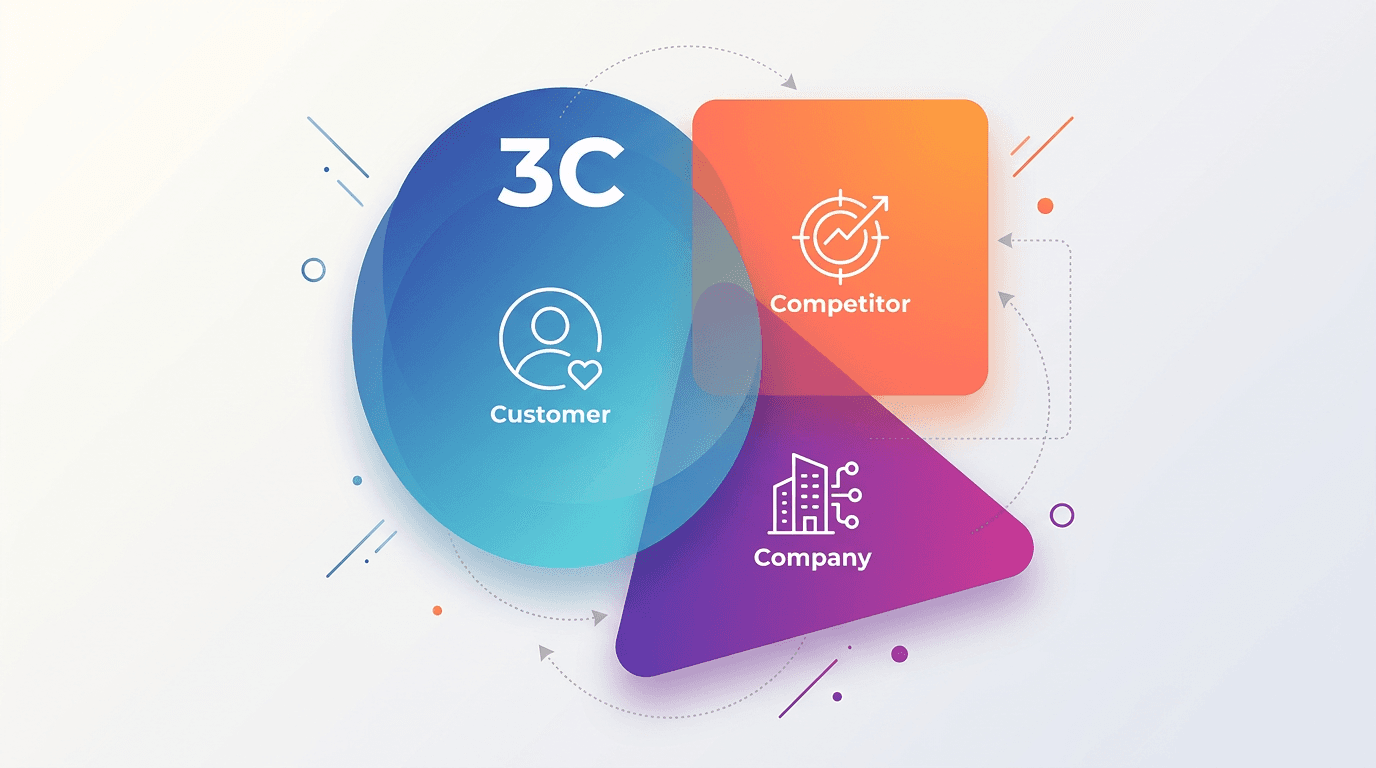
"3C analysis" is the foundational framework you should master first when building a marketing strategy. By organizing your external environment and your company's position from three perspectives—Customer (market and customers), Competitor (competition), and Company (yourself)—it lays the groundwork for deciding "where to compete" and "how to win."
This article systematically covers what 3C analysis is, the key issues to address in each component, how it differs from and complements other frameworks like 4P, 4C, SWOT, and PEST, a practical 5-step process, copy-paste templates, industry-specific examples, and common pitfalls with countermeasures. Use it as a hands-on guide for strategy development, new business planning, and marketing-plan formulation.
What Is 3C Analysis? The Framework That Anchors Marketing Strategy
The Meaning and Purpose of 3C Analysis
3C analysis is a framework that organizes the business environment from three perspectives—Customer (market and customers), Competitor (competition), and Company (yourself)—to set the direction of business and marketing strategy. By placing Customer and Competitor (the external environment) alongside Company (the internal environment), you can answer the core strategic question: "What value does the market want, that competitors fail to provide, and that we can deliver?"
The purpose of 3C analysis is to design business moves grounded in objective facts rather than gut feel or individual judgment. By examining market size, needs, competitor moves, and your own resources in parallel, you can identify a winning position and prioritize where to invest your limited resources.
Origin and Historical Background
3C analysis was systematized by management consultant Kenichi Ohmae in his 1980s book "The Mind of the Strategist," and from there it spread globally. It rests on the idea that the heart of corporate strategy lies in the relationships among three actors: customers, competitors, and the company itself.
Earlier strategy theory tended to focus heavily on internal analysis, but Ohmae anchored strategy in market reality by starting from "what customers truly need" and "the relative gap with competitors." Because it is simple yet captures the essentials, it remains a standard tool today in marketing, new business development, and corporate planning.
Why 3C Analysis Still Matters Today
In today's mature markets, where customers have an explosion of choices, you cannot win them over by deciding moves based solely on your own convenience. 3C analysis serves as a thinking checklist that grounds your judgments not only in your own capabilities but also in customer needs and the gap with competitors—helping you avoid self-centered strategies.
- Strategic discussions stay grounded in market and competitor reality, not just "what we want to do"
- The key questions for entering or exiting a new business are organized without omissions
- It becomes easier to prioritize which markets and customers to concentrate limited resources on
- It connects smoothly to downstream marketing design like STP, 4P, and 4C
The Three Components of 3C Analysis
Each of the three Cs has its own set of representative issues to address. Below, we explain why "Customer → Competitor → Company" is the standard order of analysis and walk through what each component contains.
Customer (Market and Customers)
Customer is the section where you understand the demand-side structure—market size, growth rate, customer needs, buying behavior, and so on. The reason to analyze it first within the 3Cs is that without defining "the market your business should serve," you cannot give meaning to either competitors or your own strengths.
The main issues to consider for Customer are as follows.
- Market size (TAM, SAM, SOM) and growth rate: is it expanding or shrinking going forward?
- Customer segments: who is the main buyer—by age, occupation, industry, company size, etc.?
- Customer needs and challenges: what are the underlying jobs to be done behind surface-level wants?
- Purchase process: the customer journey from awareness to purchase, decision-makers, and other stakeholders
- Purchase drivers: which do customers prioritize—price, quality, brand, or convenience?
- Market trends and changes: regulation, technological innovation, shifts in consumer values
For Customer, what matters is grasping "the facts of the actual market" rather than "the customer image you want to see." Build your evidence by combining multiple primary and secondary sources—government statistics, industry reports, interviews with existing customers, surveys, and web behavior data.
Competitor (Competition)
Competitor is the section where you analyze how other companies serving the same customer problem in the same market are behaving. By understanding competitors' strategies, strengths, and weaknesses, you can see "the arena where you can win" and "the head-on fights to avoid."
The issues to consider in competitor analysis are as follows.
- Identifying competitors: list direct competitors (same category) and also indirect competitors (substitutes and alternative means)
- Market share and trends: who is the leader, who is the challenger, and is share rising or falling?
- Target customers and positioning: who do they target with what value proposition?
- Product, pricing, and channel strategies: how do they differ from others on the 4P axes?
- Strengths and weaknesses: where do they have the edge—technology, brand, distribution, customer base, or cost structure?
- Performance and investment trends: predict future moves from recent earnings, hiring, and press releases
The essence of competitor analysis is capturing, without omission, "all parties competing for the same customer's wallet and time." If you only watch direct industry peers, you miss new entrants from other industries and disruption from substitute technologies. Reverse-engineer from the customer's problem and treat "every option that can solve that problem" as a competitor.
Company (Yourself)
Company is the section where you evaluate how your firm can compete within the market structure described by Customer and Competitor. The key is to relativize your strengths and weaknesses—not as absolutes, but in relation to "market needs" and "competitors."
The issues to consider in Company analysis are as follows.
- Mission, vision, and mid-to-long-term strategy: what are we ultimately aiming for?
- Strengths and weaknesses of the product/service: what's the difference for customers compared with competitors?
- Management resources (people, things, money, information): accumulated technology, talent, capital, brand, and data
- Performance and financials: revenue, profit, growth rate, profit structure, cash flow
- Organizational capabilities: decision speed, development power, sales power, customer success
- Brand assets and customer base: relationships with existing customers; repeatable sales and marketing motions
Avoid abstract statements like "our strength is quality." Define strengths through the lens of others—customers and competitors—for example: "On the △△ dimension that customers in the ○○ segment value most, we deliver around ◯× the precision of competitors A and B."
How 3C Analysis Compares with and Complements Other Frameworks
3C analysis isn't meant to stand alone. Combining it with other frameworks dramatically increases the resolution of your strategy. Below we sort out the differences from frameworks that are often confused with 3C and how to combine them in practice.
3C vs. 4P / 4C Analysis
3C analysis is "environmental analysis to set the direction of the business," while 4P and 4C analysis are "marketing mixes for designing concrete tactics." They sit at different layers.
- 3C: take a panoramic view of market, competitors, and self to decide which market to serve and what value to deliver
- 4P: design tactics from the company's viewpoint—Product, Price, Place, Promotion
- 4C: translate to the customer's viewpoint to refine tactics—Customer Value, Cost, Convenience, Communication
In practice, the standard flow is: "use 3C to set strategic direction → narrow targets with STP → translate into specific tactics with 4P/4C."
The Relationship Between 3C and SWOT Analysis
SWOT analysis—Strengths, Weaknesses, Opportunities, Threats—fits neatly as a downstream step that integrates the results of 3C analysis to derive strategy.
A clean handoff is to extract Opportunities and Threats from SWOT out of the Customer/Competitor sections of 3C, and Strengths and Weaknesses out of the Company section. From there, you can move directly into cross-SWOT (strengths × opportunities = offensive strategy; weaknesses × threats = defensive strategy).
The Relationship Between 3C and PEST Analysis
PEST analysis captures the macro environment along four axes: Politics, Economy, Society, and Technology. Running PEST before the Customer step of 3C helps you grasp the structural drivers that change markets and customer behavior.
A two-stage approach—using PEST to read the broader currents and 3C to analyze "the market, competitors, and self that you face"—gives you a robust strategy that combines short-term and long-term, and micro and macro perspectives.
3C vs. 5C Analysis
5C analysis is an expanded version of 3C that adds Co-operator (partners) and Climate (the macro environment), and it shines for complex businesses with many stakeholders—B2B and global expansion in particular. The practical rule of thumb: when 3C falls short on information, switch to 5C; when speed of decision-making matters most, 3C is enough.
The Relationship Between 3C and STP Analysis
STP analysis (Segmentation, Targeting, Positioning) is the framework for slicing the market and deciding "which customers to target and how to be perceived." The most common strategy-formulation flow is: use 3C to grasp the structure of the market and competition, then narrow to "the customer to target and the way to win" with STP, and finally translate that into tactics with 4P/4C.
How to Run a 3C Analysis: A Practical 5-Step Process
Anyone can fill in the boxes of a 3C analysis, but to use it as a strategic tool, the order and the design of the questions matter. Below is a 5-step process you can repeat reliably in practice.
Step 1: Clarify the Purpose and Scope of the Analysis
The first thing to do is articulate, in a single sentence, "why we are doing this 3C analysis." Whether it is a decision to enter a new business, a review of an existing one, or new-product strategy formulation, the relevant scope of market, competitors, and self changes dramatically.
Specifically, decide the following:
- Purpose of the analysis (entry decision / strategy review / new product design / investment decision)
- Target business domain, product category, and region
- Target customer segment (B2B/B2C, industry, company size, age group, etc.)
- Output format and decision-makers (who will decide what based on it?)
- Deadline and required information sources
If you start gathering information without clear purpose and scope, the more data you collect, the blurrier the conclusion becomes. Deciding upfront "what we want to decide based on this 3C" is what determines the quality of the eventual strategy.
Step 2: Customer Analysis (Understand Market and Customer Needs)
Next is Customer analysis. Combine macro information—such as market size and growth rate—with micro information—such as the needs and buying behavior of your target customers.
- Macro: grasp market size and growth from industry reports, government statistics, and research-firm data
- Micro: gather qualitative input through interviews and surveys with existing or prospective customers, plus reviews and social-media chatter
- Behavioral: confirm actual behavior with access logs and purchase data from your website, ads, and MA/CRM tools
- Unmet needs: extract the points where customers are "putting up with inconvenience" or "compromising on the current options"
Top-down macro data alone won't generate on-the-ground tactics. Always dig into the voices and behaviors of real customers, and probe down to "what specific challenges they have, and where the existing options leave them stuck."
Step 3: Competitor Analysis (Strategies, Strengths, and Weaknesses)
List the competitors operating in the market you defined in Customer analysis, and compare strategies, strengths, and weaknesses. The trick is to capture not only direct competitors but also "any alternative means that solve the same customer problem."
- Listing competitors: extract three layers—direct (same category), indirect (substitutes), and potential entrants
- Public sources: corporate sites, IR materials, press releases, recruiting pages, social accounts
- Product evaluation: try the product yourself, take a demo, check review sites
- Customer-side input: ask your own customers about their experience with competitors (reasons for switching, satisfaction)
- Comparison table: arrange the players along axes such as price, features, target, channel, and support
Evaluate each competitor's strengths and weaknesses not from your own viewpoint but from "how target customers see them." Rather than "they are #1 in the industry, so they are strong," concretize down to "they are superior on the ○○ dimension that target customers prioritize." That level of specificity gives you the raw material to judge "where we can win" in the next step.
Step 4: Company Analysis (Resources and Position)
Once you can see the structure of market and competition, relativize and evaluate your own company. The point here is not to list "the things we are good at," but to judge "what resonates—and what doesn't—against the needs of the market."
- Inventory of resources: technology, talent, capital, brand, customer base, data, etc.
- Articulation of value provided: what problems do your products and services actually solve for customers?
- Relative comparison with competitors: add yourself to the comparison table built during Competitor analysis to visualize the position
- Performance and KPIs: pin down current state in numbers—revenue, profit, retention, LTV, CAC, etc.
- Bottleneck identification: which weaknesses or resource gaps are blocking growth?
Splitting your strengths into "areas where we are already winning" and "areas where, with sharpening, we can win" makes the strategic moves more concrete. Always back each strength claim with evidence (customer evaluations, track record, patents, technical scores, financial indicators, etc.).
Step 5: Extract the KSF and Translate It into Strategy
Finally, integrate the three Cs to derive a KSF (Key Success Factor). A KSF is "the decisive point that your company must own to win in this market," and reaching it is the goal of 3C analysis.
The framing for extracting a KSF is:
- What Customer wants (market need),
- What Competitor cannot satisfy (competitor weakness),
- What Company can deliver (your strength),
- Identify the area where these three conditions overlap
Once the KSF is visible, translate it into concrete strategy, tactics, and KPIs. Connect it to downstream steps: target narrowing (STP), value-proposition definition, tactical design via 4P/4C, and KPI design. Only when you go this far does 3C analysis become a "design document for strategy" rather than a "report."
3C Analysis Templates: Copy-Paste Lists
Building a 3C from scratch takes time. Here are two templates you can copy directly into a document or spreadsheet.
Simple Version Template
Use this as a quick-start version. It's designed for narrowing each C to 5–7 items and building a skeleton in one or two hours.
【Customer (Market and Customers)】
- Target market / category:
- Market size and growth rate:
- Main customer segments:
- Main customer needs / challenges:
- Decision drivers at the moment of purchase:
- Market trends and changes:
- Unmet needs / dissatisfaction:
【Competitor (Competition)】
- Direct competitors (3–5 companies):
- Indirect competitors / substitutes:
- Competitor targets / positioning:
- Competitor strengths:
- Competitor weaknesses:
- Competitor share and performance trends:
- Outlook for the competitive landscape:
【Company (Yourself)】
- Vision and business domain:
- Value proposition / flagship products:
- Strengths (based on customer feedback and track record):
- Weaknesses / issues:
- Resources (people, things, money, information):
- Performance / key KPIs:
- Bottlenecks blocking growth:
SWOT-Integrated Template
This is an extended version that flows directly from 3C results into a SWOT analysis. It works well when preparing materials for executive or board-level discussions.
- External environment (extracted from Customer and Competitor)
- Opportunity: market growth, unmet needs, deregulation, technology trends, etc.
- Threat: shrinking market, rise of substitutes, tightening regulation, more new entrants, etc.
- Internal environment (extracted from Company)
- Strength: points that resonate with customers compared to competitors; unique resources
- Weakness: areas inferior to competitors, resource gaps, organizational issues
- Cross SWOT
- Strength × Opportunity: offensive strategy (apply strengths to market opportunities)
- Strength × Threat: differentiation strategy (defend against threats with strengths)
- Weakness × Opportunity: reinforcement strategy (shore up weaknesses so opportunities aren't lost)
- Weakness × Threat: exit / scale-down strategy (preparation for the worst-case scenario)
The point of a template isn't to "fill in the boxes." Always ask whether what you've written in each box ultimately connects to your KSF and action plan.
3C Analysis Examples by Industry
Because 3C is highly abstract, examples accelerate understanding dramatically. Below are example fills for three typical business types. Use whichever is closest to your situation as a base, then adjust.
Example 1: B2B SaaS (Marketing Analytics Tool)
Customer (Market and Customers)
- Target market: domestic marketing analytics / MMM / attribution SaaS market, growing at double-digit rates year over year
- Customer segments: marketing departments at mid-cap and large enterprises with revenue between roughly ¥5–50 billion, in both B2B and B2C
- Needs: optimizing ad-spend allocation, measurement after the deprecation of third-party cookies, accountability for investment to leadership
- Decision-makers: the CMO or marketing lead, with sign-off involving executives and IT
- Unmet needs: existing tools are operationally heavy, vendor-dependent, and rarely go beyond reporting into actual decision support
Competitor (Competition)
- Direct competitors: large overseas MMM/attribution SaaS vendors and domestic reporting-tool vendors
- Indirect competitors: in-house solutions built on top of BI tools, one-off analytics projects from consulting firms
- Competitor strengths: brand and global track record; integration with existing BI ecosystems
- Competitor weaknesses: shallow coverage of Japanese media and business practices; limits in UI and Japanese-language support; heavy PoC design
Company (Yourself)
- Strengths: design optimized for Japanese media and data sources, recommendation-engine technology, lightweight PoC and hands-on operational support
- Weaknesses: limited overseas track record, response to enterprise security requirements
- Resources: a small, engineer-heavy team; limited sales and marketing budget
KSF: "design that engages deeply with Japanese measurement challenges" plus "operational ability to surface ROI quickly within a PoC." Build the strategy on direct proposals to mid-market CMOs and trust-building through case-study content.
Example 2: D2C Brand (Skincare)
Customer (Market and Customers)
- Target market: D2C skincare and the sensitive-skin category, expanding on the back of the sustainable-consumption trend
- Customer segments: women aged 30–45 with a natural-living orientation who care about ingredients and manufacturing background
- Needs: fundamental improvement of skin issues, peace of mind around ingredients and methods, empathy with the brand's worldview
- Unmet needs: fatigue with the uniform messaging from major brands, slow adoption of refills and other sustainability practices
Competitor (Competition)
- Direct competitors: established domestic D2C skincare brands and natural-leaning indie brands
- Indirect competitors: the sensitive-skin lines of large cosmetics manufacturers, overseas organic brands
- Competitor strengths: brand recognition, distribution networks, and ad spend
- Competitor weaknesses: thin storytelling around ingredients and manufacturing, price-led messaging, weak subscription/refill design
Company (Yourself)
- Strengths: founder story rooted in formulation research, refill design, an Instagram-based fan community
- Weaknesses: offline trial opportunities, awareness, total ad budget
- Resources: own EC and LINE infrastructure, content output centered on the founder
KSF: combine "specialized formulation expertise that works for sensitive skin" with "product design that operationalizes sustainability plus fan-community management." Don't rely on ads alone for awareness—reinforce credibility with UGC and expert content.
Example 3: A Local Restaurant
Customer (Market and Customers)
- Target market: residential area within walking distance of a station, mainly dual-income households and singles
- Customer segments: workers in their 30s–50s (weekday lunch and remote-work use); family households (weekend dinner)
- Needs: dependable, reliable taste for everyday use; an atmosphere where families feel welcome; visit-worthy occasions for special days
- Unmet needs: fatigue with chain restaurants' uniform menus, limited takeout options
Competitor (Competition)
- Direct competitors: other independent restaurants in the area, chain restaurants near the station
- Indirect competitors: delivery services, prepared meals and meal kits, home cooking
- Competitor strengths: chain restaurants' price and consistent quality, brand recognition of popular shops
- Competitor weaknesses: fixed menus, uniform service, lack of local-sourcing storytelling
Company (Yourself)
- Strengths: direct sourcing from local producers, the chef's training pedigree, kid-friendly seating
- Weaknesses: awareness, weeknight dinner traffic, limited staff
- Resources: small family-run team, presence on Google Maps and Instagram
KSF: combine "the absence of menu fatigue from local-sourced rotating dishes" with "flexible seating that works for both families and singles." Absorb demand swings with takeout and delivery, and aim to build repeat customers via inflow design rooted in Google Maps and local search.
Common Pitfalls in 3C Analysis—and How to Counter Them
Because 3C is a simple framework, the pitfall of "filling it out for show without ever connecting it to strategy" is common. Below are four representative failure modes, each with countermeasures.
Pitfall 1: Filling the Boxes from Subjective Impressions
A 3C built from a one-hour internal brainstorm is essentially a transcript of the participants' impressions—it doesn't ensure objectivity. If your perception of market and competitors is off, every strategic move stacked on top will be off.
The countermeasure is to require an "evidence source" for each item. Make it a rule to fill the boxes citing industry reports, statistics, customer interviews, log data, competitor IR materials, and so on. This separates fact from hypothesis and lifts the quality of the discussion.
Pitfall 2: "Strengths" Become Inward-Looking, Not Customer-Focused
Cases where Company strengths are listed as "long history," "high engineering skill," or other self-evaluations are very common. But unless customers perceive these as value, they aren't strategic strengths.
The countermeasure is to phrase strengths along "the evaluation axes the target customer cares about × comparison with competitors." If you can write "On the △△ dimension that the ○○ segment values, we are clearly superior to competitors A and B," it passes. If you can't, it's likely a strength only the company believes in.
Pitfall 3: The Analysis Doesn't Feed into Strategy or KSF
Another typical failure is filling out the three Cs and stopping there—leaving "what we will decide based on this" vague. The real value of 3C analysis lies in Step 5: extracting the KSF and connecting it to action.
The countermeasure is to define the final 3C output not as a "3C summary table" but as a set: KSF + 3–5 strategic hypotheses + actions, owners, and KPIs for the next 3–6 months. Locking in the output format upfront keeps analysis and decisions from being severed.
Pitfall 4: Built Once, Never Updated
Markets, competitors, and your own company can change significantly within six to twelve months. Yet in many organizations, a 3C analysis is built once at a new business launch or mid-term plan kick-off and then sits dormant in a file.
The countermeasure is to put "moments to refresh the 3C" on the calendar—half-year reviews or annual strategy meetings—and run a light update of only the items that have changed. Tying the 3C to data that moves daily and weekly (analytics, ad reports, CRM data) lets you spot market and competitor shifts faster and keeps the strategy fresh.
Putting 3C Analysis to Work in Advertising and Marketing Strategy
3C analysis is often discussed in the language of corporate strategy, but it's also highly effective in day-to-day advertising and marketing. In fact, the disconnection between the tactical layer and the 3C results is often why teams complain that "tactics don't move the needle and improvement ideas are shallow."
- Targeting design: feed the customer segments and needs from Customer analysis directly into ad targeting and messaging axes
- Creative messaging: turn "what competitors don't say" and "what customers still aren't getting" (from Competitor analysis) into your USP
- Media allocation: align the budget and channels with the awareness / consideration / purchase phases of the customer journey
- Measurement framing: connect the KPIs from Company analysis with ad KPIs and evaluate beyond ROAS / CPA—within the context of business KPIs
Particularly important is connecting the strategic hypotheses extracted in 3C with your measurement framework. Combining attribution analysis with marketing mix modeling (MMM) lets you continuously verify "whether budget is being allocated as the 3C strategy intended, and whether revenue impact is in line with the assumption." Connecting the strategy framework and the measurement infrastructure in the same language is the shortcut to repeatable marketing.
Conclusion: 3C Analysis Is the Starting Point of Strategy and the Foundation of Repeatable Growth
3C analysis is the framework that organizes the business environment into Customer, Competitor, and Company, and forms the foundation for deciding "where to compete" and "how to win." Finally, here are the key takeaways.
- 3C is an environmental-analysis framework that puts external (Customer, Competitor) and internal (Company) factors side by side
- It was proposed by Kenichi Ohmae and remains a standard today because it's simple yet captures the essence of strategy
- The standard combination is: "use PEST/3C to read the environment, integrate with SWOT, narrow customers with STP, and translate into tactics with 4P/4C"
- The 5-step process: "purpose & scope → Customer → Competitor → Company → KSF extraction and strategy formulation"
- Quality is preserved by citing evidence sources, framing strengths in relative terms (vs. customer expectations and competitors), and refreshing the 3C periodically
- When the design extends to ad operations and measurement, 3C functions not as a strategic document but as an everyday decision engine
Start by writing a 3C for your main business using the simple template in this article. Don't aim for completeness—what matters most is finishing one full pass. Share what you've written internally, fill in the missing data, and refine it through a customer and competitor lens. That cycle itself is what raises the resolution of your strategy.