4C Analysis: How It Differs from 4P and Why Customer-Centric Marketing Wins
May 1, 2026
Author: Shusaku Yosa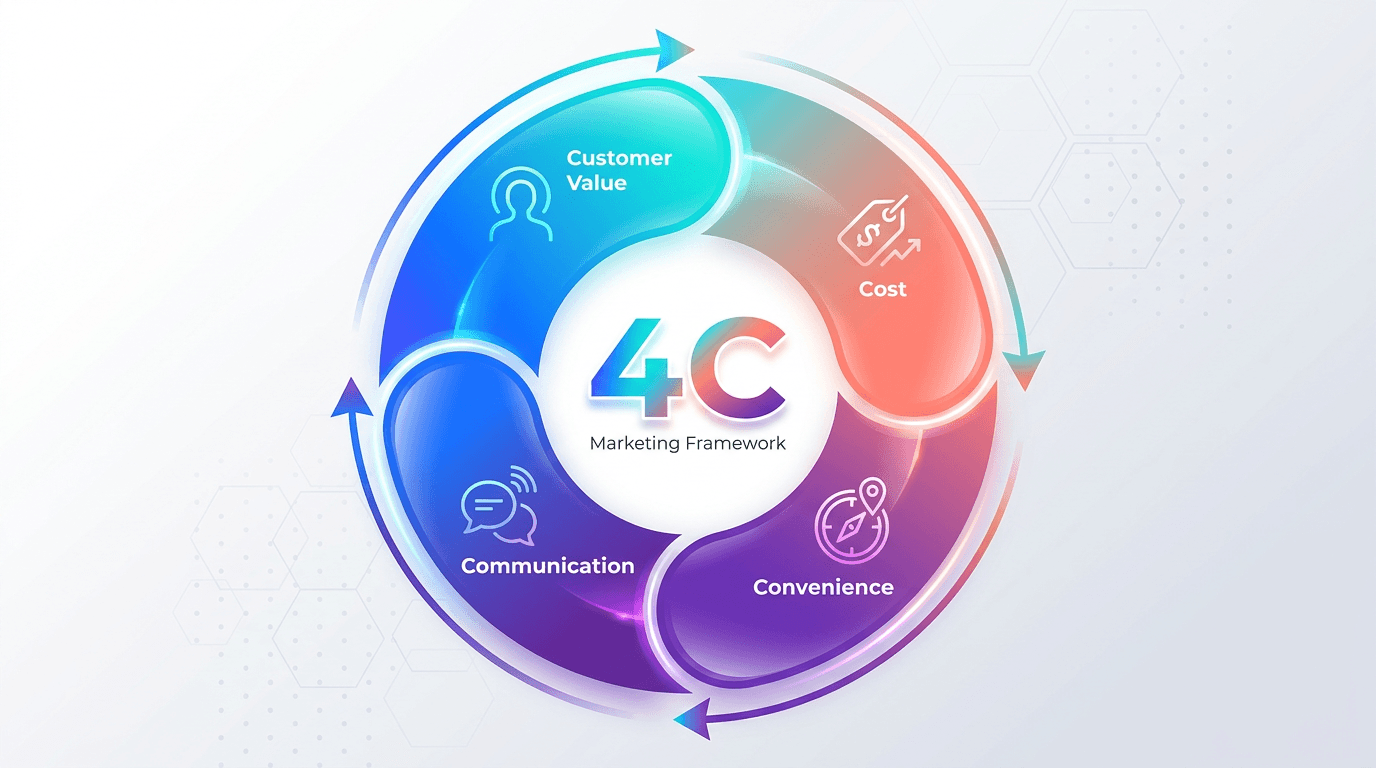
4C analysis is a framework for designing marketing strategy from the customer's perspective rather than the company's. By rethinking your initiatives across four lenses—Customer Value, Cost, Convenience, and Communication—you can avoid self-centered strategies and design experiences that genuinely match what buyers want.
This article provides a systematic walkthrough of what 4C analysis is, what each element means, how it differs from 4P analysis, a practical 5-step process, industry-specific examples, and common pitfalls and countermeasures. Even if you already know 4P, treat this as a hands-on guide for sharpening strategy through a customer-centric lens.
What is 4C analysis? A customer-centric marketing framework
Meaning and purpose of 4C analysis
4C analysis is a framework for reconstructing marketing strategy from the buyer's point of view. Rather than starting with what the company wants to sell, it starts with how the customer feels, decides, and acts—organizing four elements around their experience.
The purpose of 4C analysis is to verify that your initiatives create value that is actually meaningful to the customer. For example, even if a company emphasizes "high performance," the product will not sell if customers do not perceive that as valuable. Translating into the 4C lens prevents strategies built on internal assumptions.
Originator and historical context
4C was proposed in 1993 by Robert F. Lauterborn in the United States. It was created out of a concern that the 4P framework, proposed by E.J. McCarthy in 1960, was overly biased toward the seller's perspective—and reframed each 4P element into a customer-centric counterpart.
The backdrop was a shift in the era: as choices proliferated and SNS and word-of-mouth empowered consumers to gather information themselves, marketing moved from "build it and they will come" to an era where customers select products based on their own definition of value. A customer-perspective framework became essential.
The four elements of 4C analysis
Each element of 4C corresponds one-to-one with an element of 4P, with the perspective shifted from "company" to "customer." Let's start with the core questions for each element.
Customer Value
Customer Value refers to the value or benefit a customer obtains through your product or service. It corresponds to Product in the 4P framework, but the focus is not on features and specifications—it is on the meaningful benefit perceived by the customer.
Key questions to consider:
- Which customer problem or job does it solve?
- Should you emphasize functional value (performance, ease of use) or emotional value (peace of mind, status)?
- Why would the customer choose you instead of an alternative?
- How does your brand and worldview contribute to the customer's identity?
- What kind of experience and outcome does the customer get after purchase?
Cost (the customer's cost)
Cost refers to every burden the customer takes on to obtain the product. It corresponds to Price in 4P, but the key is to capture not just the dollar amount but also time, effort, and psychological burden.
Costs that are easy to overlook include:
- Monetary cost: list price, shipping, subscription fees, maintenance
- Time cost: research time, delivery lead time, implementation hours
- Learning cost: time to learn how to use it, internal training time
- Psychological cost: fear of failure, friction of switching from another vendor
- Opportunity cost: alternatives the customer gives up by choosing you
Even at the same price, the lower these surrounding costs are, the smaller the total burden becomes for the customer.
Convenience
Convenience refers to how easy it is for the customer to find, buy, and use the product. It corresponds to Place in 4P, but rather than the layout of stores or channels, the question is "how smooth is it from the customer's standpoint?"
- Can the customer find information instantly when they need it (searchability, site flow)?
- Can they buy it the moment they want to (inventory, payment options, hours)?
- Can they receive it where and when they want (delivery options, store network)?
- Can they easily reach support and inquiries?
- Are digital and in-person experiences seamlessly connected (OMO)?
Convenience is an area where competitive differentiation is unusually clear. With the same product, "available immediately" and "effortless to use" become reasons customers choose you.
Communication
Communication refers to two-way dialogue between the company and the customer. It corresponds to Promotion in 4P, but the essence is not one-way "promotion"—it is hearing the customer's voice and building a relationship through dialogue.
- Does the customer receive the right information at the right time?
- Are you capturing customer voice through SNS, reviews, and support?
- Do you respond to inquiries and requests promptly and sincerely?
- Can you sustain ongoing relationships through community and fans?
- Can customers empathize with the brand's story and values?
4C vs 4P: A correspondence table of perspectives
4C and 4P are not in opposition; they are complements that look at the same phenomenon from "company" and "customer" sides. The correspondence is as follows:
- Product ↔ Customer Value: what to make / what is meaningful to the customer
- Price ↔ Cost: what price to set / how much the customer bears
- Place ↔ Convenience: where to sell / where it is easy to buy
- Promotion ↔ Communication: how to inform / how to dialogue
In practice, after organizing your initiatives in 4P, retranslate the same content into 4C and check "how this looks to the customer"—you will quickly see whether your strategy is self-centered. Conversely, for new businesses or strategy reviews, starting with 4C to define customer problems and value, then expanding into 4P for concrete tactics, also works well.
The key is never to complete the work in just one of them. 4C alone leans too heavily toward the customer and loses profitability; 4P alone forces ideas onto customers without their buy-in. Moving back and forth between the two is what produces results in marketing mix design.
How 4C compares with other frameworks
To deepen your understanding of 4C, it helps to clarify the differences from frameworks that are easily confused with it.
Difference from 3C analysis
3C analysis—Customer (market and customer), Competitor, and Company—is a framework proposed by Kenichi Ohmae in the 1980s for analyzing the external environment and the company's position within it.
3C is "environmental analysis to set the overall direction of the business," while 4C is "a tool to design specific marketing initiatives from the customer's perspective." In practice, the standard flow is to use 3C first to set strategic direction, then move into 4C to build out the substance of the initiatives.
Difference from 5C analysis
5C analysis is an extended version of 3C that adds Co-operator (partners) and Climate (macro environment) for a broader view of the business environment. It is particularly useful for B2B and global expansion.
4C specializes in designing customer touchpoints, while 5C is for capturing the external factors surrounding the business comprehensively. The two are different in scope, so the choice depends on your purpose.
Relationship with STP analysis
STP analysis—Segmentation, Targeting, Positioning—is a strategy framework for slicing the market and deciding which customer segment to target. 4C is a tool for designing how to deliver value to that target customer once they are defined, so it sits downstream of STP.
Relationship with SWOT analysis
SWOT analysis organizes a company's Strengths, Weaknesses, Opportunities, and Threats. While 4C takes the perspective of "how the customer perceives things," SWOT takes the perspective of "the environment surrounding the company"; the two are complementary. Setting strategic direction with SWOT and then designing concrete customer touchpoints with 4C works well.
How to run 4C analysis: a practical 5-step process
Like 4P, simply filling in the boxes turns 4C into a worksheet. To make it function as a strategic tool, run through the following five steps.
Step 1: Define the target customer and persona
4C analysis starts by clarifying "whose perspective am I taking?" If the target is fuzzy, the criteria for each element drift and your descriptions stay abstract.
Beyond demographics like age, gender, and occupation, dig into the problems they hold, their decision-making process, the channels they use to gather information, and the competitive products they currently use. If you have multiple segments, the standard practice is to create separate 4Cs for each high-priority persona.
Step 2: Map the customer journey on a timeline
Lay out the persona's journey from "becoming aware of the product" through "buying it" and "using it" on a timeline. By imagining concretely what they feel, what questions they have, and what they compare at each touchpoint, you'll see what kind of information should go into each element of 4C.
If you already have customers, gather "actual voices" through interviews, surveys, and review analysis to raise the precision of the analysis. Don't fill in only with hypotheses—use real customer language and behavioral data as your foundation.
Step 3: Fill in each 4C element from the customer's perspective
Now fill in 4C. The key here is to make sure the subject of every sentence is "the customer." Rewriting "our XX feature is excellent" to "the customer obtains XX value" naturally flips you to the customer's viewpoint.
- Customer Value: what value or outcome does the customer get from this product?
- Cost: what is the total cost the customer bears in money, time, and effort?
- Convenience: where, how, and with how much effort can the customer obtain it?
- Communication: what kind of dialogue, support, and community can the customer engage in?
Step 4: Cross-check against 4P for consistency
Place your filled-in 4C side by side with the corresponding 4P. Wherever "your 4P" and "the 4C as the customer perceives it" diverge, you've found an improvement opportunity.
- Are the features you emphasize in Product resonating with the customer as Customer Value?
- Even if Price is low, is the Cost actually high (implementation hours, learning cost, etc.)?
- Are the channels in Place really optimal for the customer in Convenience terms?
- Is your Promotion truly Communication—or has it become one-directional?
Finding gaps is the greatest value of 4C analysis. The chasm between "what we think is good" and "what is actually good for the customer" is where you have room to grow against the competition.
Step 5: Translate into improvement actions and KPIs
Finally, convert the issues you've identified into concrete improvement actions. For each C, document "the actions to start in the next 3–6 months," "the owner," and "the KPI to measure."
Example KPIs: customer satisfaction and NPS for Customer Value; checkout completion rate and churn for Cost; site bounce rate and average delivery days for Convenience; response time and SNS engagement for Communication. Tying the discussion to quantitative metrics prevents 4C from becoming a "draw it and forget it" exercise.
4C analysis examples by industry
Here are example 4C entries for three typical business types. Adjust the one closest to your situation to get a feel for how to write.
Example 1: B2B SaaS
- Customer Value: reduces the coordination burden between marketing and sales and lifts opportunity creation rates. Reassurance that ad-hoc lead handling is now systematized.
- Cost: monthly fee, plus internal coordination hours for onboarding, the operations owner's learning time, and migration risk from existing tools.
- Convenience: free trial that begins instantly online; dedicated CS who guides implementation; integrations with existing tools (CRM, MA).
- Communication: regular post-onboarding reviews, user community and meetups, best-practice webinars, inquiries answered within one business day on average.
Example 2: A D2C brand
- Customer Value: empathy with skin-friendly ingredients and environmental care. Satisfaction of being someone who practices sustainable consumption.
- Cost: unit price is somewhat higher, but ongoing cost is moderated through refills. Delivery within three days of order keeps waiting stress low.
- Convenience: self-operated EC, subscription, and pop-ups for hands-on experience. Order, delivery changes, and cancellation all completed via LINE.
- Communication: live Q&A on Instagram, online events for purchasers, regular product-development storytelling.
Example 3: A neighborhood restaurant
- Customer Value: peace of mind from local ingredients and the fun of daily-changing menus. A special-occasion atmosphere for anniversaries.
- Cost: lunch is on par with the local average, dinner is slightly higher but felt to be worth it for the experience. Takeout means zero wait.
- Convenience: 5 min walk from the station; web reservations, phone, and walk-in all welcome; delivery available for at-home enjoyment.
- Communication: LINE updates for regulars, Instagram stories about today's specials, careful replies to reviews.
Common pitfalls in 4C analysis and how to address them
Pitfall 1: Drifting back into the company's perspective (4P)
Even when you intend to write from the customer's perspective, the descriptions can drift back into selling features and strengths as you go. The countermeasure is to recheck the subject of each sentence after writing—if you've written "our XX," rewrite it as "the customer XX".
Listing 4C and 4P side by side on the same sheet for cross-checking is also effective. Going back and forth between the two perspectives makes it easier to spot company-centric phrasing.
Pitfall 2: Filling in based on hypothesis alone, without the real customer
Filling out 4C only in internal meetings tends to depict a customer the way you wish they were. A 4C that is out of sync with real customers will not raise strategic precision.
As a countermeasure, always bring in primary sources of customer voice—interviews with existing customers, support logs, reviews on third-party sites and SNS, and survey results. A data-backed 4C dramatically changes the persuasiveness and reproducibility of the discussion.
Pitfall 3: Analysis that doesn't connect to execution
Drawing the 4C and stopping there—with no change in the field—is another common pattern. Tie each C to "actions starting within six months," "owners," and "KPIs," and put a regular review cadence on the calendar.
Furthermore, because the results of 4C analysis affect ads, LPs, CS, and product across multiple departments, the operating design must involve those departments rather than relying on a single owner.
Summary: 4C analysis is the foundational tool for sharpening strategy from the customer's perspective
4C analysis is a framework for translating 4P into the customer's perspective—avoiding self-centered marketing and designing experiences that are meaningful to the buyer. Let's recap the key points.
- 4C is a customer-centric marketing framework with four elements: Customer Value, Cost, Convenience, and Communication
- Proposed by Lauterborn in 1993, it complements 4P by translating each element into the customer's perspective
- 4P and 4C are not in opposition; cycling between both raises the precision of the marketing mix
- The process is a five-step flow: define target → visualize the customer journey → fill in 4C → cross-check with 4P → operationalize
- Grounding in primary customer information rather than hypothesis alone, and tying each C to action plans, owners, and KPIs, is the key to success
As a starting point, pick one target persona for your flagship product and write up a 4C. Reading it side by side with the 4P for the same product will reveal what is missing from the customer's perspective. That gap is the starting point for your next move.