
Google Ads Campaign Types: Formats, Bidding, and How to Choose
April 21, 2026
Author: Shusaku Yosa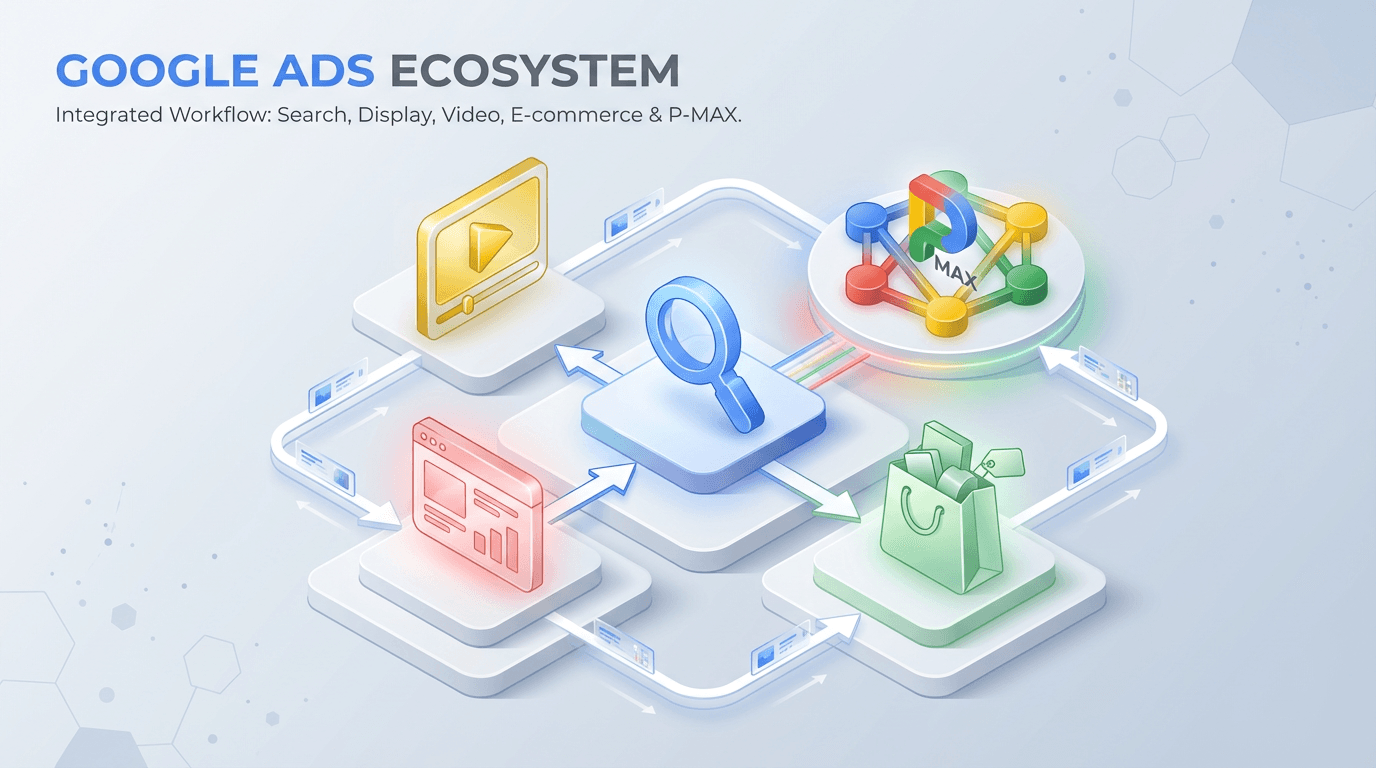
Choose Google Ads by separating campaign type, ad format and automation. Search campaigns, responsive ads and automated bidding are not equivalent categories. First decide the business outcome you can measure reliably, then choose a campaign that fits the demand, creative and operating capacity available.
Three different decisions
Layer | Examples | Decision |
|---|---|---|
Campaign type | Search, Display, Video, Performance Max | Which delivery system to use |
Ad format or asset | Responsive search ads, images, video | How to communicate the offer |
Delivery or bidding feature | Automated bidding, audience signals | What to optimize and what information to provide |
Compare common campaign options
Option | Decision context | Preparation |
|---|---|---|
Search | Reach people searching for a problem or product | Search intent, copy and a relevant destination |
Display | Build visual contact or re-engage an audience | Images, placement controls and audience rules |
Video | Explain or introduce an offer through video | Creative, viewing context and outcome measures |
Demand Gen | Develop demand through visual experiences | Images or video, measurement and audience hypotheses |
Shopping | Present products to shoppers comparing options | Merchant Center product information and selling terms |
App | Acquire or engage app users | App information and in-app measurement |
Performance Max | Pursue defined outcomes across multiple channels | Reliable conversion data, creative and relevant product information |
These are common options, not a promise that every account displays the same choices. Consult Google’s campaign selection guide and the account’s current setup flow. AI optimization does not guarantee a lower acquisition cost, and using video does not guarantee sales.
Performance Max uses asset groups
Performance Max organizes creative into asset groups, for example around a theme. Do not copy a standard Search ad-group setup and assume the same structure applies. Audience signals are suggestions rather than strict limits on who can see the ads: Google explicitly describes delivery outside the supplied signals.
Measurement quality comes first. If failed submissions or duplicate events are counted as valuable leads, changing campaign type will not fix the evaluation problem. Separate primary outcomes from supporting actions and review values, counting rules and optimization goals.
Check retired formats and changed names
Call-only ads should not be presented as a new standalone campaign choice. Google’s migration guidance states that new call-only ad creation ended in February 2026 and existing call-only ads will stop receiving impressions in February 2027. Review the transition to responsive search ads with call assets.
Older instructions for Video Action campaigns also need to be read alongside the Demand Gen migration guidance. Confirm the campaign’s current type rather than looking only for a screen label copied from an old tutorial.
A practical selection worksheet
Imagine a fictional business service seeking qualified inquiries. If relevant comparison searches exist, a suitable landing page is ready and valid inquiries can be distinguished from spam, Search may be a reasonable first test. If customers need help recognizing the problem and search demand is limited, visual or video-led activity may also deserve a test. This illustrates decision conditions, not a forecast of results.
Worksheet field | What to decide |
|---|---|
Customer and problem | Who needs to understand what, and take which action? |
Outcome definition | A purchase or inquiry that meets the business requirement |
Creative and destination | Whether the page delivers the promise in the ad |
Budget and observation period | A cap including production and management, plus a review date |
Decision criteria | Valid outcomes, cost, quality and measurement reliability |
Start within a scope that lets you test a clear hypothesis. When adding another campaign, review overlap and attribution rather than adding all reported conversions together. Document what changed, who owns the decision and what evidence would justify expanding the test.
Related guides
- Responsive Ads: RSA vs. RDA, Asset Requirements, and Testing
- Paid Search Management: A Weekly Optimization Checklist
- Video Advertising Formats: Placement, Creative, and Measurement
Review your results consistently
For ongoing data aggregation, comparison and reporting, review NeX-Ray’s integrations and features. Check the plan requirements for your analysis, then start for free.
Sources and verification
Public documentation checked on October 1, 2026. Availability and interface details can vary by account and market; check the linked documentation before configuring a campaign.