How to Create a Customer Journey Map | A Practical Guide Even Beginners Can Follow
March 25, 2026
Author: Shusaku Yosa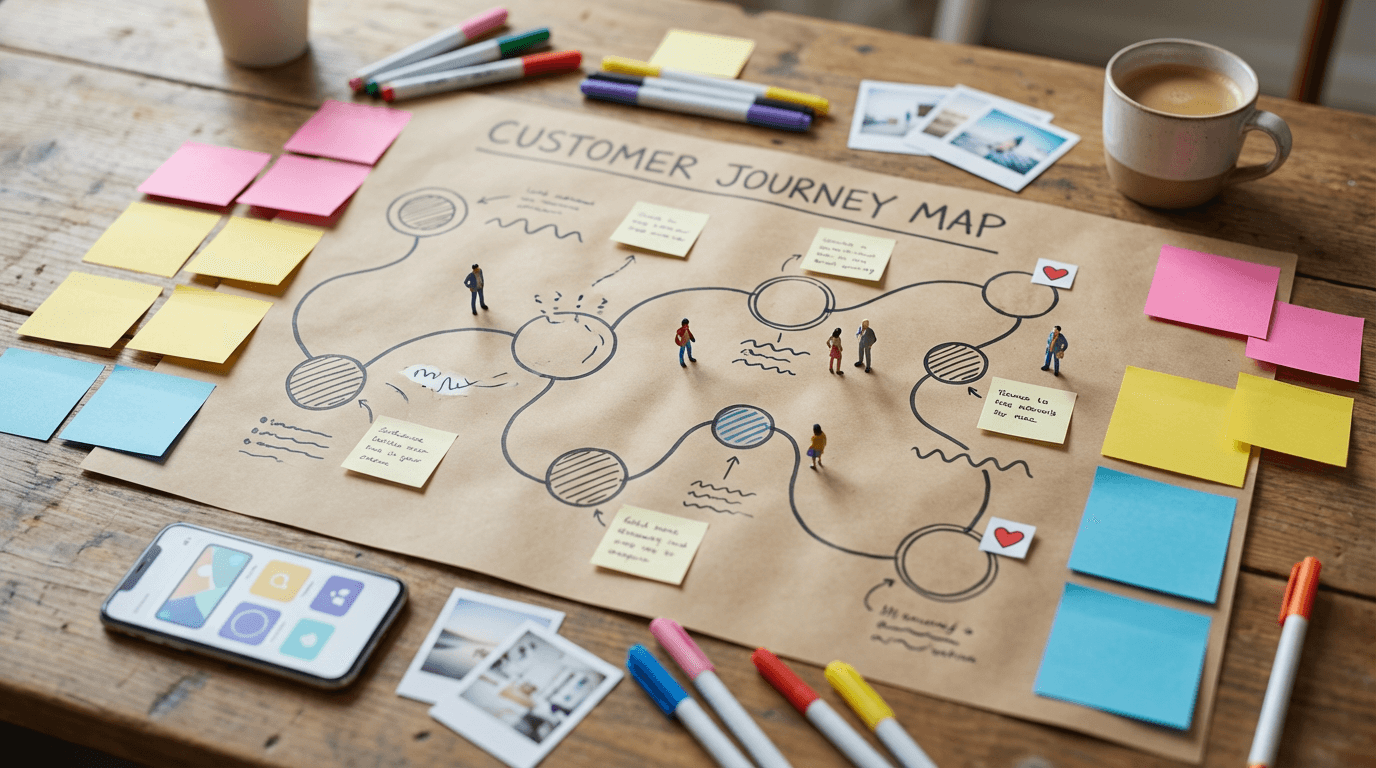
"I want to create a customer journey map, but I don't know where to start." "I filled in a template, but it doesn't feel actionable." — These are comments frequently heard from marketing professionals. A customer journey map is a powerful framework that visualizes customer actions, thoughts, and emotions over time to identify optimal initiatives. However, if created incorrectly, it becomes a "made it and done" document that never translates into real-world tactics. This article provides a complete step-by-step guide that enables even beginners to create a customer journey map without hesitation and connect it to concrete campaign improvements.
What Is a Customer Journey Map?
A customer journey map is a visual diagram that traces the process a customer goes through from first becoming aware of a product or service, through purchase and use, to advocacy — organized chronologically. It captures not just customer actions but also thoughts, emotions, touchpoints (contact channels), and pain points at each stage, all organized into a single view.
The greatest value of a customer journey map is that it provides a panoramic view of the customer experience from the "customer's perspective" rather than the "company's perspective." Companies tend to focus on "what we offer," but customers navigate the buying process through diverse information sources including competitors, word of mouth, and social media. A customer journey map captures this complex customer behavior holistically and clarifies what your company should do at each stage.
Why You Need a Customer Journey Map
Addressing the Complexity of Customer Touchpoints
As of 2026, the number of touchpoints before a purchase continues to grow. Learning about a product on social media, researching on search engines, checking reviews on rating sites, watching YouTube reviews, and finally purchasing on an e-commerce site — this kind of multi-channel purchasing behavior has become the norm. B2B is similar, with information gathering through webinars, white papers, comparison sites, and social media before first contact with sales. Customer journey maps are essential tools for organizing this complex customer behavior and designing campaigns without gaps.
Preventing Initiative Silos
In many organizations, SEO, advertising, social media, and email teams independently pursue their own KPIs without coordination. Creating a customer journey map makes it clear which stage each initiative covers, revealing coordination opportunities and uncovered gaps. The result is the ability to design a consistent cross-channel customer experience.
Clarifying Improvement Priorities
Drawing an emotion curve on a customer journey map makes it immediately clear where pain points (sources of frustration and drop-off) exist. These pain points are the top improvement priorities. To maximize marketing results with limited resources, focusing initiatives on the moments customers struggle most is the most efficient approach, and customer journey maps help inform that decision.
Preparing to Create a Customer Journey Map
Define the Purpose
Before starting to create a customer journey map, clarify "why you're making it." Whether it's to design the customer experience for a new service, identify bottlenecks in existing acquisition funnels, or share customer understanding across the organization — the purpose determines the map's granularity and scope. Starting without a clear purpose tends to produce an unwieldy document overloaded with information.
Collect Necessary Data
Customer journey maps should never be built on imagination alone. Aim for a "fact-based" map grounded in data. Useful data sources include GA4 user behavior data (traffic sources, page flows, exit points), ad platform conversion data, social media engagement data, qualitative data from customer surveys and interviews, customer support inquiry content, and sales team feedback.
Using an integrated dashboard like NeX-Ray to cross-reference GA4, ad platform, and social data enables efficient identification of which channels and paths customers use to reach your company. Capture overall trends with quantitative data and dig deeper into individual customer psychology with qualitative data — this dual approach forms the foundation of a high-quality customer journey map.
How to Create a Customer Journey Map | 5 Steps
Here we break down the customer journey map creation process into five steps. Beginners should start small with a single persona and expand to multiple personas or detailed versions as they gain experience.
Step 1: Define Your Persona
A customer journey map is built around a specific customer persona. A map targeting "all customers" becomes too abstract to be actionable. Select your most important target customer and define their profile in concrete detail.
For B2B, define industry, company size, job title, responsibilities, challenges, decision criteria, and information-gathering channels. For B2C, specify age, gender, occupation, lifestyle, values, and regularly used social media and platforms. While personas are fictional characters, basing them on real data from customer surveys, interviews, and sales feedback creates a realistic customer journey map.
Step 2: Define Journey Phases
Next, divide the customer's path to purchase into stages (phases). A common framework uses six stages: Awareness, Interest, Consideration, Purchase, Usage/Retention, and Advocacy. Customize these to fit your business model.
For example, a B2B SaaS company might use: Problem Recognition, Information Gathering, Comparison, Free Trial, Paid Subscription, Adoption, and Upsell. An e-commerce site might use: Awareness, Product Search, Comparison, Add to Cart, Purchase, Review/Repeat. Four to seven stages is a manageable range. Too granular leads to information overload; too coarse misses useful insights.
Step 3: Map Actions, Touchpoints, Thoughts, and Emotions for Each Phase
This is the core step of the customer journey map. For each phase, organize four elements.
First, "Actions" — describe what the customer specifically does in that phase. For the awareness phase, examples include "seeing industry news on social media," "hearing about a challenge from a colleague," or "searching on Google."
Second, "Touchpoints" — list the channels and media the customer encounters. These include social media, search engines, your website, blog articles, email newsletters, ads, sales representatives, trade shows, and review sites. GA4 traffic source data and ad data are helpful for accurate mapping. NeX-Ray's ability to view multi-channel data on one screen enables efficient organization of which touchpoints function at which phases.
Third, "Thoughts" — articulate what the customer is thinking at each phase. Examples include "Is there a solution to this problem?" "Which tool fits our company?" and "Is the cost-effectiveness worth it?" Customer interviews, survey open-ended responses, and customer support inquiries serve as key inputs.
Fourth, "Emotions" — map the customer's emotions ranging from positive (anticipation, reassurance, satisfaction) to negative (anxiety, confusion, frustration). Visualizing emotional shifts as an "emotion curve" makes it intuitive to identify where pain points exist in the customer experience.
Step 4: Identify Issues and Pain Points
Based on the information organized in Step 3, identify issues and pain points at each phase. Areas where the emotion curve dips negative, touchpoints with high drop-off rates, and processes with frequent customer complaints are all candidates for improvement.
For example, articulate specific issues like "users drop off during the comparison phase because differences from competitors aren't clear," "the purchase completion rate after adding to cart is low due to complex form entry," or "the transition rate from free trial to paid subscription is low." GA4 funnel analysis and page-level exit rate data provide quantitative validation. Using NeX-Ray's dashboard to review end-to-end data from ads to site behavior helps you pinpoint exactly which phase contains the bottleneck.
Step 5: Add Initiative Ideas and Set Priorities
Finally, add initiative ideas to address identified issues directly on the customer journey map. This is the most critical step for preventing your map from becoming a "create and forget" artifact. For each issue, document what initiative will solve it, which channel will be used, which team owns it, and the priority level.
Prioritize initiatives using a simple yet effective matrix of "Impact (expected improvement magnitude) × Ease of Implementation (minimal resources and time needed)." Start with high-impact, easy-to-implement initiatives, accumulating small wins to embed a journey-map-driven improvement culture within your organization.
Components of a Customer Journey Map
While there is no fixed format for customer journey maps, they typically organize elements along horizontal and vertical axes. The horizontal axis displays journey phases (Awareness, Interest, Consideration, Purchase, Usage/Retention, Advocacy). The vertical axis lists persona actions, touchpoints, thoughts, emotions (emotion curve), issues/pain points, and initiative ideas.
Beginners should start with just three elements — actions, touchpoints, and emotions — and add thoughts, issues, and initiatives as they gain confidence. There's no need to aim for a perfect customer journey map from the start.
Differences in Customer Journey Maps for B2B and B2C
B2B Customer Journey Maps
B2B is characterized by longer purchasing processes with multiple stakeholders involved in decisions. Three key considerations for B2B journey maps: First, create separate maps for each decision-making persona (field staff, department managers, executives) or annotate multiple stakeholder perspectives on a single map. Second, cover the entire long process from lead generation through nurturing, opportunity creation, and close. Third, accurately capture diverse touchpoints including white papers, webinars, emails, sales visits, and demos.
B2C Customer Journey Maps
In B2C, individual emotions and impulse behaviors significantly influence the journey. Social media word-of-mouth, influencer impact, the connection between in-store and online experiences (OMO), and post-purchase advocacy through reviews and social sharing mean touchpoints tend to be even more diverse than in B2B. B2C customer journey maps should place particular emphasis on the emotion curve, detailing emotional fluctuations like "impulse buying," "comparison fatigue," "delivery wait anxiety," and "unboxing excitement" to uncover experience improvement opportunities.
Common Customer Journey Map Mistakes and Solutions
Mistake 1: Building from the Company's Perspective
The most common mistake is creating a map that simply lists "what the company wants to do." For example, listing "Ad delivery → LP visit → Form submission → Sales call" represents the company's operational flow, not a customer journey map. The fundamental premise is to describe what the customer thinks, feels, and does. Use customer interviews and behavioral data to fill in the map using the customer's own words.
Mistake 2: Creating Without Data
This happens when stakeholders gather in a meeting room and build a journey map based purely on assumptions. Guessing that "customers probably think this" tends to produce a map disconnected from reality. Collect data from both quantitative and qualitative sources — GA4 user behavior data, ad conversion paths, social engagement data, and customer interviews — before starting. With NeX-Ray enabling cross-channel data review, you can understand actual customer behavior patterns on a fact-based foundation.
Mistake 3: Creating Without Connecting to Initiatives
Completing a customer journey map and saving it as a document without translating it into initiatives. A journey map is not a "create and done" exercise but a "starting point for initiatives." Converting identified issues into actionable tasks with assigned owners and deadlines is the complete package. Regularly review the map and update it alongside initiative effectiveness verification.
Mistake 4: Never Updating After Initial Creation
Markets and customer behaviors are constantly evolving. Leaving a customer journey map unupdated for years risks widening the gap with reality and basing campaigns on incorrect assumptions. Validate the map's accuracy with data at least every six months and update as needed. It's also important to reflect external changes like new social media platforms and shifts in information-gathering behavior driven by AI.
Mistake 5: Mixing Multiple Personas
Mixing different personas' actions and emotions into a single customer journey map makes it unclear whose experience is being depicted. New and existing customers, enterprise procurement managers and SMB owners have vastly different journeys. The principle is one persona per map — if personas differ, create separate maps.
Applying Customer Journey Maps to Initiatives
Content Marketing Applications
If you can identify the information customers need at each journey phase, that becomes your content marketing blueprint. Awareness phase: blog articles that articulate challenges. Interest phase: how-to articles and white papers. Consideration phase: case studies and comparison content. Purchase phase: ROI simulations and implementation guides. You can position the optimal content at each journey stage.
Advertising Strategy Applications
Customer journey maps can inform ad targeting and creative design. Use reach-focused social and display ads at the awareness phase, branded search and listing ads at the consideration phase, and retargeting ads after drop-off. Varying ad objectives and messaging by phase improves ad investment efficiency. Managing ad performance at each phase with NeX-Ray enables you to visualize the role and results of advertising across the entire journey.
Site Improvement and CVR Optimization Applications
Once pain points are identified through the customer journey map, directly connect them to site improvement and CVR optimization initiatives. For example, if "users drop off during the comparison phase because they can't find needed information," candidate solutions include restructuring the LP, enriching comparison content, and adding chat support. If "users drop off during form entry," solutions include form optimization (EFO) and switching to step-based forms. Verify initiative effectiveness through A/B testing and roll out winning patterns.
Tools for Creating Customer Journey Maps
Customer journey maps can be created without specialized tools. The simplest method is using a spreadsheet (Google Sheets or Excel) with phases on the horizontal axis and elements on the vertical axis. For team workshop-style creation, online whiteboard tools like Miro or FigJam are convenient, offering a sticky-note-like experience.
More important than tool selection is the quality of information in the map. No matter how sophisticated the tool, a customer journey map won't drive results if the underlying data and customer understanding are shallow. Focus first on establishing an environment where you can comprehensively understand GA4, ad, and social data, and accurately capture actual customer behavior.
Conclusion
A customer journey map is a framework that visualizes customer actions, thoughts, and emotions over time to guide optimal initiatives at each stage. In 2026, with increasingly complex customer touchpoints, it is an indispensable tool for designing consistent cross-channel customer experiences.
The creation process follows five steps: define the persona, define journey phases, organize actions/touchpoints/thoughts/emotions for each phase, identify issues and pain points, and translate into initiative ideas. Beginners should start small with one persona and three elements — actions, touchpoints, and emotions.
The key to a successful customer journey map is creating it based on data, translating it into initiatives, and regularly updating it in a continuous cycle. Don't build on imagination alone — leverage fact-based data including GA4 user behavior, ad conversion data, and social engagement data. Using an integrated dashboard like NeX-Ray enables cross-channel customer behavior analysis, improving journey map accuracy while allowing end-to-end initiative effectiveness verification. Start by selecting your most important customer segment and building a small customer journey map.